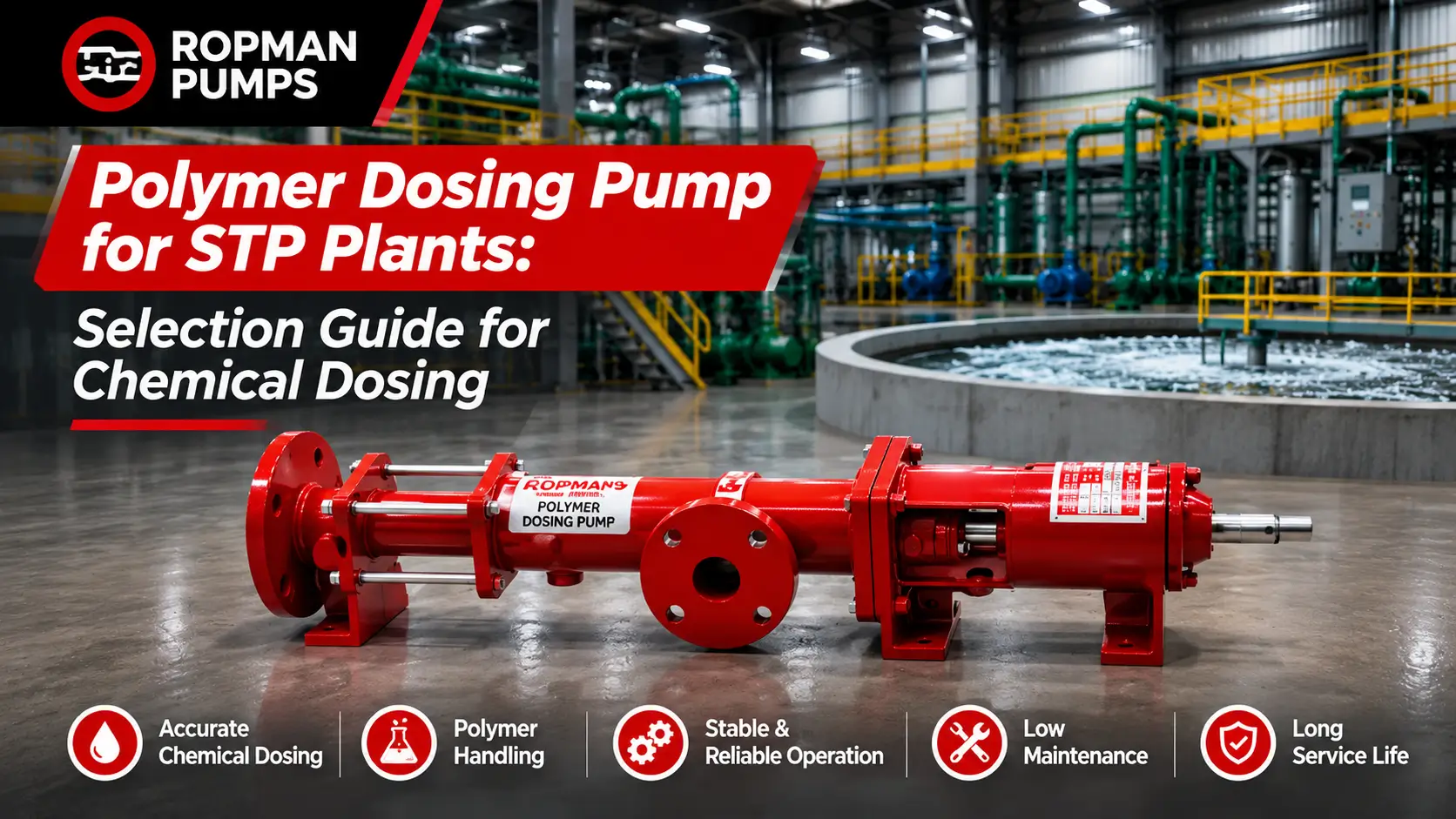
A polymer dosing pump has a small job with a big effect on a sewage treatment plant. Feed too little polymer and sludge won’t thicken or dewater. Feed too much and you waste money and foul the press belts. Pick the wrong pump and the polymer itself gets damaged. This guide explains how to choose polymer and chemical dosing pumps for an STP.
Where a Polymer Dosing Pump Is Used in an STP
Polymer is a flocculant. It binds fine particles into larger flocs so water can be separated from solids. In a sewage treatment plant, a polymer dosing pump is used in:
- Sludge thickening
- Sludge dewatering with centrifuges, belt presses or screw presses
- Clarifier and flocculation stages
- Industrial effluent treatment where solids need to settle
Other dosing pumps in the same plant handle alum, ferric chloride, caustic, acid and hypochlorite. For a wider view of pumping in a plant, read how pumps keep an STP running.
Why Polymer Is Difficult to Pump
- High viscosity. Neat liquid polymer and emulsion are thick, and the thickness rises when diluted.
- Shear sensitivity. Long polymer chains break under rough pumping, which weakens performance.
- Sticky residue. Dried polymer clogs valves and small passages.
- Accuracy. Dose must stay steady as sludge flow changes.
Best Dosing Pump Types for Polymer
Progressive cavity polymer pumps
A progressive cavity pump moves thick liquid gently and delivers flow in proportion to speed. That makes it popular for neat polymer transfer and for dosing into dilution units. Learn how it works in our progressive cavity pump guide.
Diaphragm and metering pumps
Best for thinner chemicals such as hypochlorite, acid, caustic and coagulants. A metering pump gives precise dosing at low flow. For thick polymer, a standard diaphragm pump can struggle and pulse.
Peristaltic pumps
Gentle and simple, with no valves to clog. They suit small flows but the hose needs regular replacement.
Rotary lobe and gear pumps
Occasionally used for clean viscous transfer, but their tight clearances can shear polymer, so check suitability first.
Polymer Dosing Pump Comparison
| Pump | Good for | Limit |
|---|---|---|
| Progressive cavity | Thick polymer, steady flow, low shear | Must not run dry |
| Diaphragm metering | Thin chemicals, precise dose | Pulsation, struggles with thick liquid |
| Peristaltic | Small flows, easy maintenance | Hose wear |
| Lobe / gear | Clean viscous transfer | Shear and wear |
How to Select a Polymer Dosing Pump
- Define the dose. Litres per hour, based on sludge flow and polymer dose rate.
- Know the viscosity. Both neat and diluted conditions.
- Set the pressure. Include pipe length and the injection point.
- Add speed control. A variable frequency drive lets the pump follow sludge flow.
- Protect against dry run. Add a level or flow switch.
- Keep water out of the suction. Polymer thickens sharply when it meets water in the wrong place.
Maintenance Tips
Flush lines after shutdowns so dried polymer doesn’t form plugs. Inspect rotor and stator wear if dose accuracy drifts. For more on keeping wear costs down, see how to reduce progressive cavity pump maintenance cost. Our STP pumps guide covers the other pumps in the plant.
FAQs: Polymer Dosing Pump
Which pump is best for polymer dosing?
A progressive cavity pump suits thick polymer well because it pumps gently and holds a steady flow. Diaphragm pumps suit thinner chemicals.
Why does polymer lose performance after pumping?
High shear can break polymer chains. Low-speed, positive displacement pumps limit this.
How do I control polymer dose?
Use a variable speed drive and link it to sludge flow so the dose follows the load.
Need Dosing Pumps for Your STP?
Ropman Pumps supplies pumps for dosing and sludge duty. See our dosing pump manufacturer in India page, browse the product range, or contact us for advice.
Key Takeaway on Polymer dosing pump
Use this guide on polymer dosing pump as a checklist before you request a quote.