
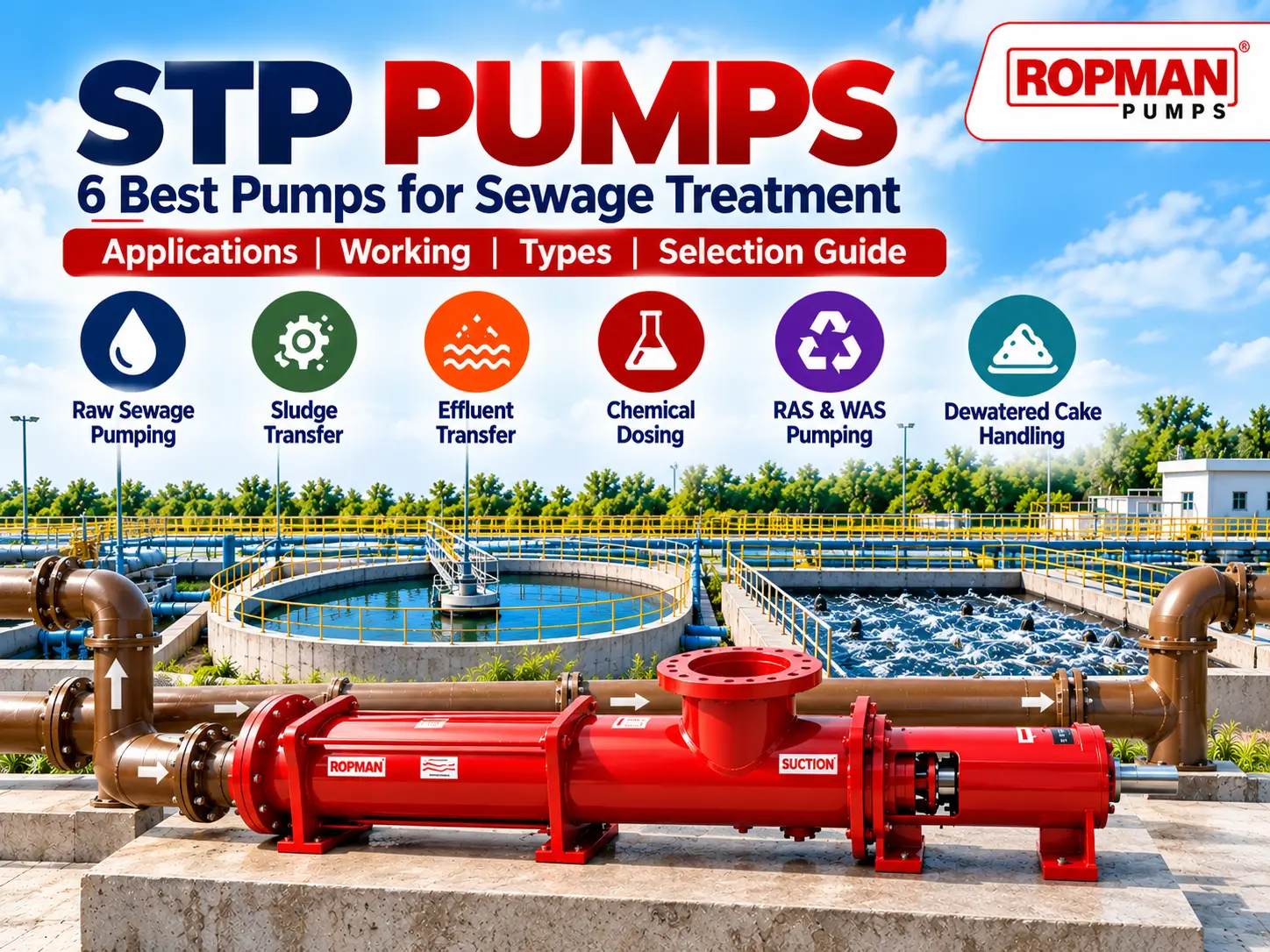
STP Pumps: 6 Best Pumps for Sewage Treatment
The six pumps that keep a sewage treatment plant running — and how to choose them.
Quick Answer
STP pumps are the pumps used across a sewage treatment plant to move sludge, effluent, and dosing chemicals. The six best STP pumps are progressive cavity pumps for raw, thickened and digested sludge, wide throat pumps for dewatered cake, and dosing pumps for polymer and lime. They are chosen because they handle thick, abrasive, solids-laden media without clogging.
On This Page
STP pumps keep a sewage treatment plant running. From lifting incoming sewage to transferring sludge and dosing chemicals, the right pumps decide whether a plant runs smoothly for years or fights constant clogging and downtime. Because sewage media is thick, gritty, and solids-laden, ordinary pumps struggle where purpose-built pumps thrive.
This guide compares the six best options, explains what each does, and shows how to choose the right one for each duty. For the pumping mechanism behind most of them, see this overview of the progressive cavity pump.
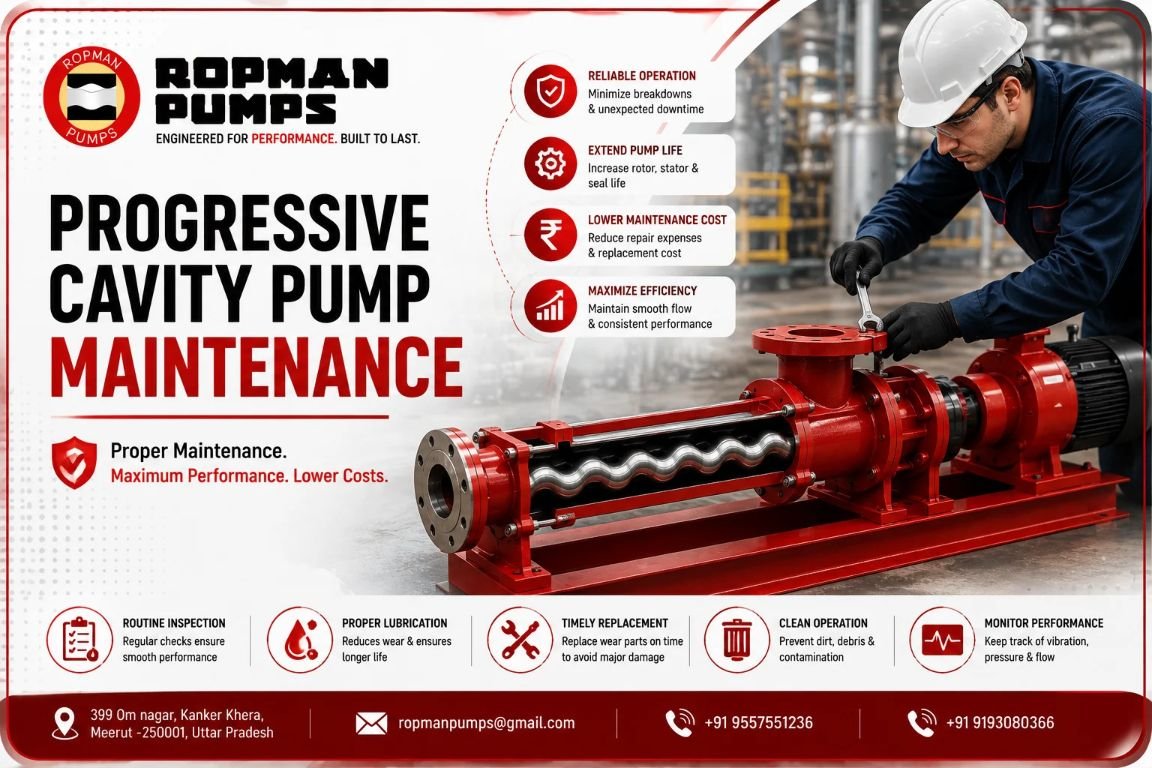 Progressive cavity STP pumps handling sludge in a sewage treatment plant.
What Are STP Pumps?
STP pumps are the pumps installed throughout a sewage treatment plant to move wastewater, sludge, and treatment chemicals between stages. Unlike a simple water pump, STP pumps must cope with high solids, grit, fibre, and corrosive conditions while running around the clock. The wrong pump clogs or wears out fast; the right STP pumps run reliably for years.
Most heavy-duty units are positive displacement types, because they move thick media gently and predictably. Alongside them, dosing pumps handle the accurate chemical addition that treatment depends on.
6 Best STP Pumps and Their Duties
These six pumps cover almost every duty in a sewage treatment plant.
1. Raw Sludge Pump
A progressive cavity pump moves settled raw sludge gently, handling the solids and grit that clog impeller pumps.
2. RAS / WAS Pump
Return and waste activated sludge needs steady, controllable flow — a classic progressive cavity duty with VFD control.
3. Thickened Sludge Pump
As sludge thickens, viscosity rises. Progressive cavity STP pumps get more efficient as the media gets thicker.
4. Dewatered Cake Pump
A wide throat pump with an auger feed forces non-flowable cake into the pumping element where nothing else can.
5. Dosing Pump
Accurate, non-pulsating dosing pumps deliver polymer and lime precisely, cutting chemical waste and improving results.
6. Digested Sludge Pump
Progressive cavity pumps transfer digested sludge from digesters to dewatering or storage without shearing it.
The best pumps are not the cheapest to buy — they are the ones that keep running when the sludge gets thick and the grit gets heavy.
STP Pump Comparison
Matching each STP pump to its media is what separates a reliable plant from a high-maintenance one.
| Duty | Media | Best STP Pump |
|---|---|---|
| Raw / primary sludge | Settled sludge, grit | Progressive cavity pump |
| RAS / WAS | Activated sludge | Progressive cavity pump |
| Thickened sludge | Viscous sludge | Progressive cavity pump |
| Dewatered cake | Non-flowable cake | Wide throat pump |
| Polymer / lime | Chemicals | Dosing pump |
| Digested sludge | Digester output | Progressive cavity pump |
How to Choose the Right STP Pumps
Selecting the right pumps correctly comes down to describing the media and duty honestly. This checklist keeps you on track.
STP pump selection checklist:
- Identify the stage and media — raw, RAS/WAS, thickened, cake, or digested.
- Measure solids percentage and check for grit and fibre.
- Define flow rate and discharge pressure with real pipe losses.
- Match the stator elastomer to the media and temperature.
- Use a wide throat pump for non-flowable cake.
- Add dry-run protection and a pressure relief valve.
- Choose a supplier with in-house spares for fast replacement.
Ropman Engineering Corporation manufactures STP pumps — progressive cavity, wide throat, and dosing pumps — in Meerut, India, with rotors and stators produced in-house. Explore our progressive cavity pumps, dosing pumps, and wastewater treatment solutions to match the right pump to every duty. For deeper background, see this reference on sewage treatment.
Why Reliability Beats Price for Sewage Plant Pumps
In a treatment plant, the real cost of a pump is not its purchase price but its downtime. When a unit fails at night or over a weekend, treated water can back up, discharge limits can be breached, and an emergency repair costs far more than the part itself. That is why experienced plant operators judge every pump on how long it runs between services, not on the invoice alone.
Three things drive that long-term reliability. First, correct sizing for the actual media, so the pump is never forced beyond its comfortable range. Second, protection features such as dry-run sensors and pressure relief valves that stop a small fault becoming a wrecked stator. Third, fast access to correctly matched spare parts, so a worn wet-end is swapped in an afternoon rather than waiting weeks for an imported component. Get these three right and the total cost of ownership drops sharply over the life of the plant.
Frequently Asked Questions
What are STP pumps?
Which is the best pump for sludge in an STP?
What pump is used for dewatered cake in an STP?
How many types of STP pumps are there?
Does Ropman manufacture STP pumps in India?
Need Reliable STP Pumps for Your Plant?
Ropman builds progressive cavity, wide throat, and dosing STP pumps with in-house spares. Tell us your stage, media, and flow, and we will size the right pump.