
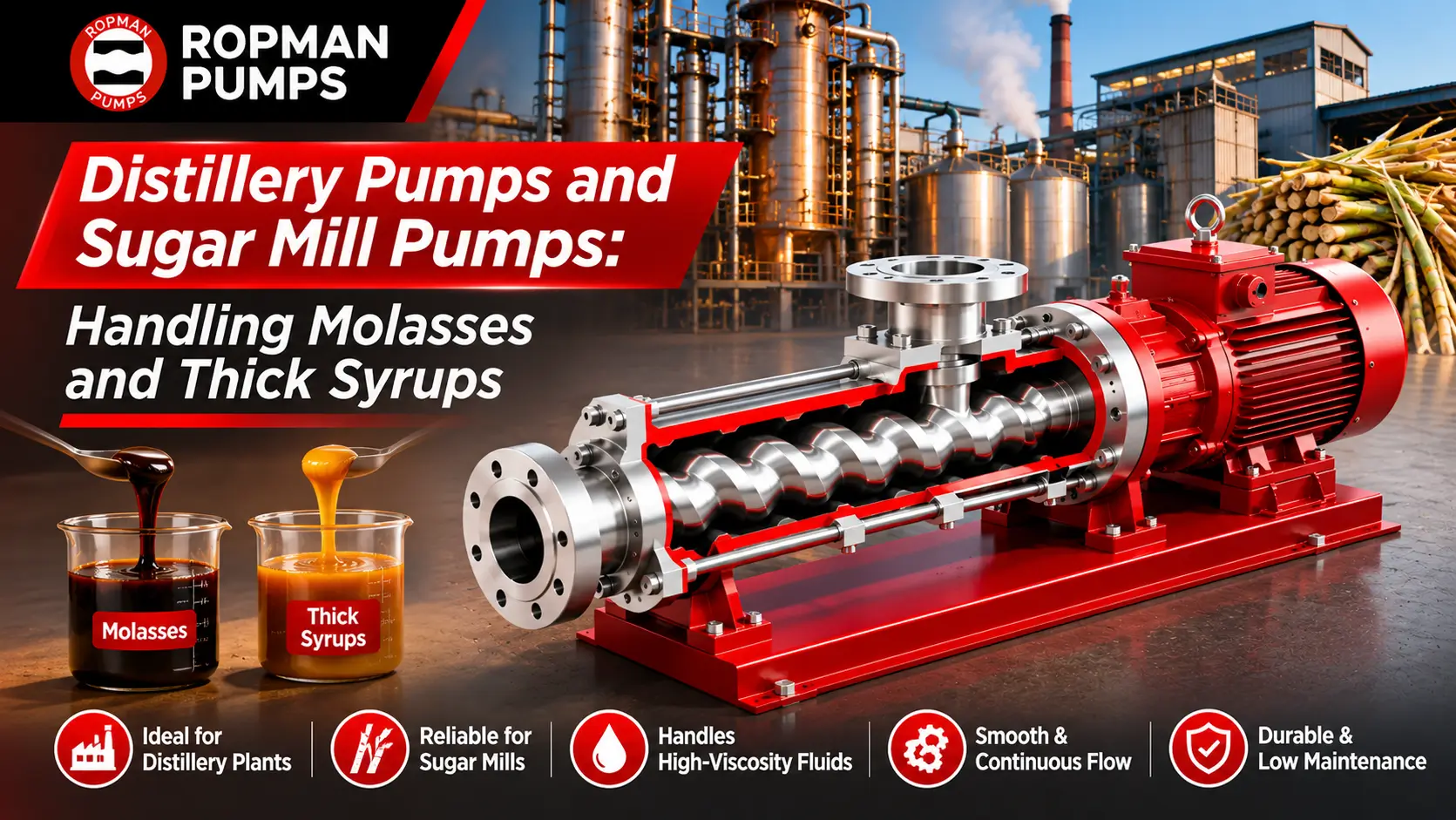
Distillery pumps face a tough mix of thick, sticky, hot and sometimes acidic liquids. Molasses barely flows in cold weather. Spent wash carries solids. Massecuite in a sugar mill can be as stiff as paste. This guide covers the main duties in distilleries and sugar mills, the pump types that work, and how to choose.

Where Distillery Pumps Are Used
- Molasses transfer: from storage tanks to fermentation or dilution.
- Fermented wash: moving wash to distillation without damaging the process.
- Spent wash (vinasse): hot, acidic liquid with suspended solids.
- Yeast and sludge: thick, shear-sensitive slurries.
- Massecuite and syrup in sugar mills: very high viscosity, with crystals.
Why Distillery Pumps Need Special Design
Viscosity moves with temperature. Molasses that pours when warm becomes almost solid when cold. A pump sized for the warm figure will stall in winter. Always size for the thickest condition.
Solids and crystals are abrasive. Sugar crystals and fibres wear moving parts quickly.
Chemistry and heat. Spent wash is hot and acidic, so metals and rubber must be chosen with care.
Process sensitivity. Yeast and fermenting liquid should not be whipped or sheared. Learn why in our guide to pumps for high viscosity fluids.
Best Pumps for Distilleries and Sugar Mills
Progressive cavity pumps
The workhorse for molasses, syrup, wash and sludge. A progressive cavity pump gives steady flow at any viscosity and handles solids at low speed. It is also self-priming, which helps with tank-level changes. See our progressive cavity pump guide.
Hopper-fed progressive cavity pumps
For the stiffest material, including massecuite and cake, a feed hopper and screw push product into the rotor. The hopper type PC pump and the wide throat pump are designed for exactly this.
Lobe and gear pumps
Useful for clean, viscous liquids such as syrup, though they struggle with abrasive solids.
Centrifugal pumps
Good for thin liquids like diluted wash or water, but a poor choice for molasses or massecuite. For the reasons, read screw pump vs centrifugal pump.
Distillery Pump Selection Table
| Liquid | Main challenge | Suitable pump |
|---|---|---|
| Molasses | High viscosity, temperature swings | Progressive cavity |
| Fermented wash | Shear sensitivity | Progressive cavity (low speed) |
| Spent wash | Heat, acid, solids | Progressive cavity with suitable materials |
| Yeast, sludge | Thick, delicate | Progressive cavity |
| Massecuite | Extreme viscosity, crystals | Hopper progressive cavity |
How to Choose Distillery Pumps
- Use the worst-case viscosity. Check the coldest start-up condition.
- Pick materials for chemistry and heat. Stainless steel parts and heat-resistant elastomer where needed.
- Run slow. Lower speed means less wear on abrasive crystals.
- Plan the suction. Short, wide lines and flooded suction help thick liquids flow in.
- Protect the pump. Add dry-run and pressure protection.
Maintenance tips that reduce downtime are in our guide to reducing progressive cavity pump maintenance cost. For background on the raw material itself, see molasses.
FAQs: Distillery Pumps
Which pump is best for molasses?
A progressive cavity pump, sized for the thickest condition and run at low speed.
Can a centrifugal pump handle molasses?
Only when it is heavily diluted or heated. In normal form, it loses flow and efficiency.
What pump moves massecuite?
A hopper-fed progressive cavity pump, since the material is too stiff to flow into a normal suction.
Get the Right Distillery Pump
Tell Ropman Pumps your liquid, temperature range and flow, and we will suggest a pump from the product range. Contact us for a quote.
Key Takeaway on Distillery pumps
Use this guide on distillery pumps as a checklist before you request a quote. If your team is still unsure about distillery pumps, share your fluid data with our engineers.