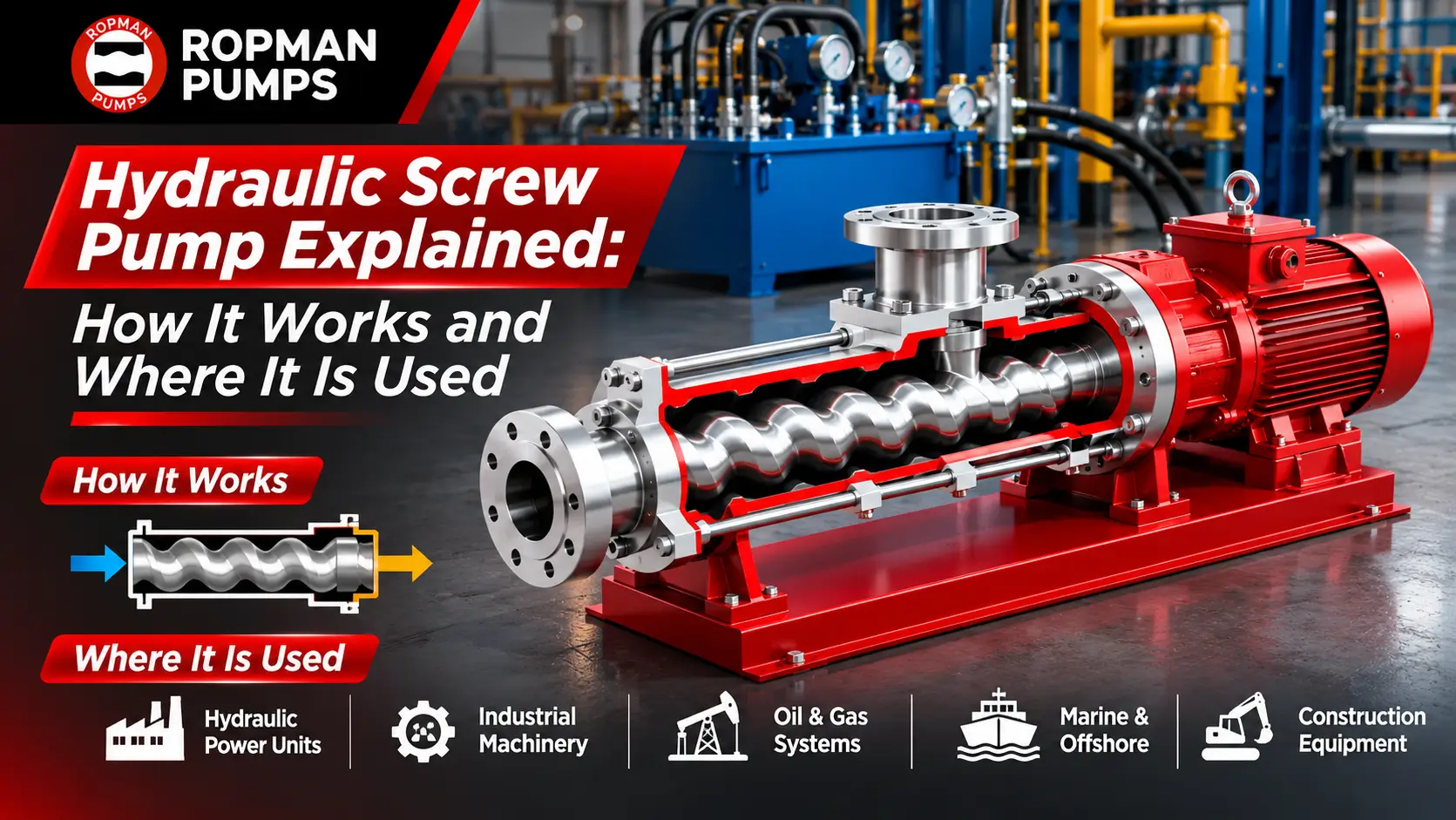
A hydraulic screw pump lifts water with a large rotating screw set in an inclined trough. Often called an Archimedes screw pump, it is one of the oldest pumping ideas still in use, and one of the best for moving large volumes of dirty water over a small height. This guide explains how it works, where it fits, and when another screw pump is the better choice.
What Is a Hydraulic Screw Pump?
A hydraulic screw pump is an open or semi-open screw that turns inside a sloped channel or tube. Liquid enters at the bottom, is trapped between the screw flights and the trough, and climbs as the screw rotates. At the top, it spills out by gravity. The principle goes back to Archimedes; see Archimedes screw for the history.
How a Hydraulic Screw Pump Works
- A motor and gearbox turn a large steel screw at slow speed.
- The screw sits at a fixed angle, usually between about 22 and 38 degrees.
- Water fills the gaps between the flights at the lower end.
- Each turn raises that water a little further up the slope.
- Water flows out at the discharge level, with no pressure build-up.
Because it runs slowly and has wide passages, rags, grit and debris pass through without blocking.
Advantages of a Hydraulic Screw Pump
- Handles debris. Little screening is needed upstream.
- Efficient across flow changes. It copes well with varying inflow.
- Low speed, low wear. Slow rotation means long service life.
- Simple operation. No tight clearances or complex controls.
- Gentle on content. Often used where fish or delicate solids are present.
Limitations to Know About
- Low lift only. It raises liquid by a few metres, usually less than about 10.
- No pressure. It cannot push liquid through a long pipeline.
- Big footprint. It needs a long inclined structure and civil work.
- Open design. Not suited to odorous, hazardous or very thick material.
Where Hydraulic Screw Pumps Are Used
- Sewage and wastewater inlet works
- Storm water and flood control stations
- Return activated sludge lifting
- Land drainage and irrigation
- Fish-friendly water lifting in rivers and hatcheries
Hydraulic Screw Pump vs Progressive Cavity Pump
| Factor | Hydraulic (Archimedes) screw | Progressive cavity pump |
|---|---|---|
| Lift / pressure | Low lift, no pressure | High pressure possible |
| Flow size | Very large volumes | Small to medium volumes |
| Liquid type | Thin, debris-laden water | Thick sludge, slurry, viscous liquids |
| Installation | Large inclined civil structure | Compact, any orientation |
| Metering | No | Yes, flow follows speed |
They solve different problems. Use a hydraulic screw to lift large water flows a short height. Use a progressive cavity pump when the liquid is thick or must go through a pipe under pressure. Our guide to the three screw pump types shows how they relate, and the progressive cavity pump guide explains the closed design.
How to Choose Between Screw Pump Designs
- Is the liquid thin water, or thick sludge?
- Do you need to lift a few metres, or push through a pipeline?
- How much flow, and how much does it vary?
- Is there room and budget for a large inclined structure?
If your duty is sludge, polymer, digestate or process fluid, see the STP pumps guide for the options that suit treatment plants.
FAQs: Hydraulic Screw Pump
How high can a hydraulic screw pump lift water?
Usually a few metres, commonly up to around 10 m, depending on design.
Why are screw pumps used in sewage plants?
They pass solids and rags without blocking and stay efficient when inflow changes.
Is a hydraulic screw pump the same as a progressive cavity pump?
No. A hydraulic screw is an open lifting screw. A progressive cavity pump is a closed positive displacement pump that builds pressure.
Need a Pump for Thick or Pressurised Duty?
For sludge and viscous liquids under pressure, Ropman Pumps builds progressive cavity pumps. Browse the product range or contact us.
Key Takeaway on Hydraulic screw pump
Use this guide on hydraulic screw pump as a checklist before you request a quote.