
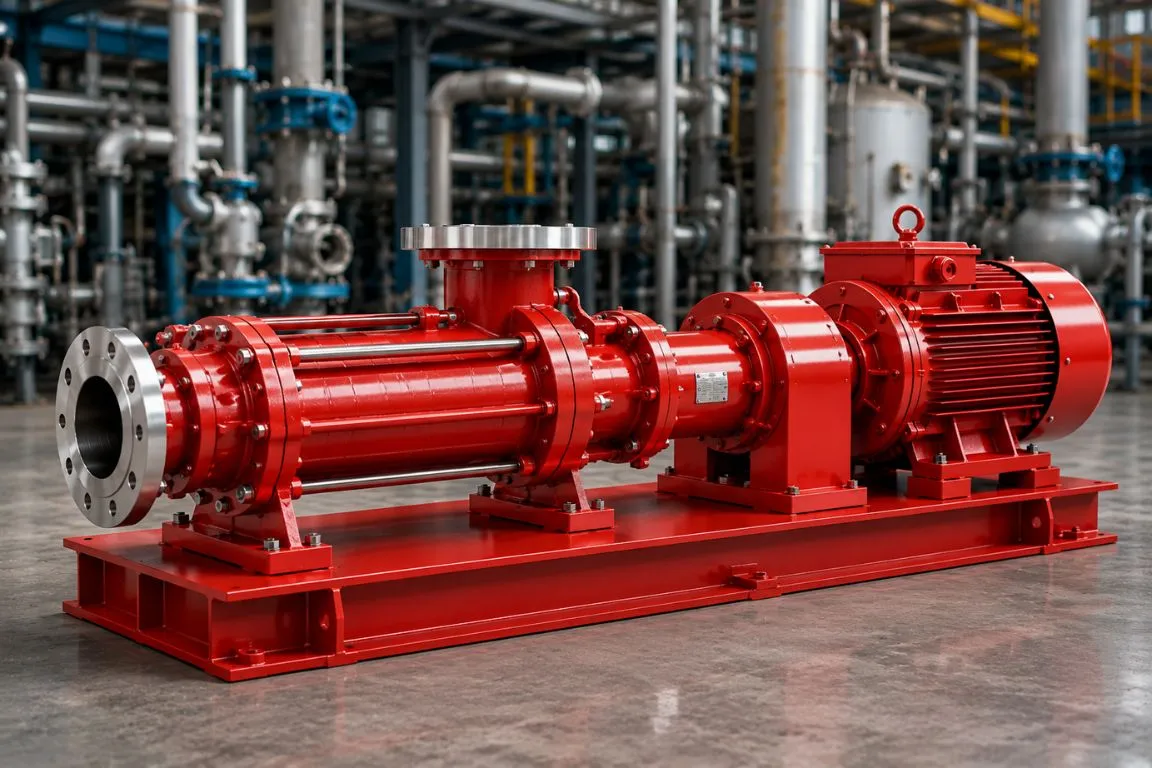
How Pumps Keep an STP Running: Complete Pump Guide
Follow the sewage through the plant and see which pump does each job, and why it matters.
Quick Answer
An STP pump system moves sewage, sludge and chemicals through every stage of a sewage treatment plant. Non-clog submersible pumps lift raw sewage and transfer it from the equalization tank. Progressive cavity pumps handle return sludge, waste sludge, thickened sludge and filter press feed. Wide throat pumps move dewatered cake, dosing pumps add chlorine and polymer, and centrifugal pumps feed filters and transfer treated water.
On This Page
- Why Pumps Are the Lifeline of an STP
- Every Duty in the STP Pump System, Stage by Stage
- STP Pump System Selection Table
- Why Progressive Cavity Pumps Dominate Sludge Duties
- How to Size an STP Pump System
- Keeping the STP Pump System Reliable
- STP Pumps from Ropman
- Progressive Cavity vs Centrifugal Pumps for Sludge
- Sizing Example: Filter Press Feed Pump
- Troubleshooting Common STP Pump Problems
- Saving Energy in the STP Pump System
- Buying Checklist for STP Pumps
- Frequently Asked Questions
Walk through any sewage treatment plant and you will hear the same sound everywhere: pumps running. A well-designed STP pump system moves sewage from the inlet to the outlet, returns bacteria to where they are needed, takes sludge to dewatering and adds chemicals in exactly the right amounts. When one pump stops, the plant soon starts to struggle.
This guide follows the sewage through a typical plant and explains which pump does each job, why it was chosen, and how to size and maintain it. For a shorter overview of the six most important sludge duties, see our article on the 6 best STP pumps.
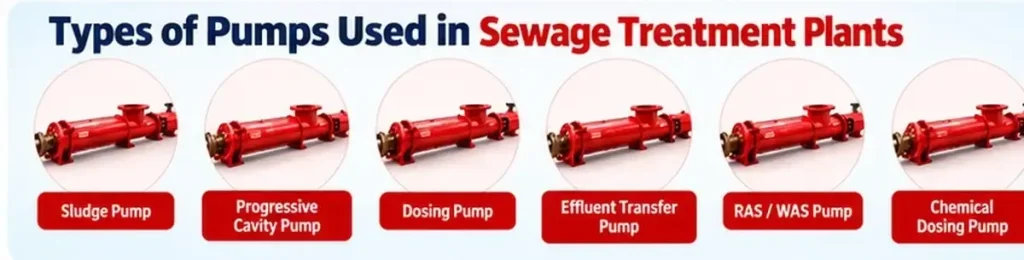
Why Pumps Are the Lifeline of an STP
Gravity can only do so much. Sewage arrives below ground level, tanks sit at different heights and sludge has to be taken out of the bottom of clarifiers and pushed through dewatering equipment. Pumps also control flow rates: the biology depends on steady feed, the right sludge return rate and accurate chemical dosing.
- Hydraulics: pumps lift sewage between units where gravity flow is not possible.
- Process control: sludge return and wasting rates set the bacteria population and sludge age.
- Solids handling: sludge and cake must be moved without clogging or damaging the floc.
- Chemistry: disinfection and dewatering depend on precise chemical dosing.
Every Duty in the STP Pump System, Stage by Stage
1. Raw Sewage Lift Pumps
Sewage reaches the plant through underground sewers and collects in a sump or wet well. Non-clog submersible pumps with open or vortex impellers lift it to the screens and equalization tank. They must pass solids and fibres, so screening upstream and resident awareness about wipes and plastics make a big difference.
2. Equalization Tank Transfer Pumps
From the equalization tank, transfer pumps feed the biological stage at a steady rate. Submersible pumps are common here, often with timers or level controls to spread flow across the day.
3. Return Activated Sludge (RAS) Pumps
Settled sludge from the clarifier is returned to the aeration tank to keep the bacteria population healthy. RAS flow must be steady and adjustable. A progressive cavity pump with a VFD gives flow proportional to speed, so operators can set the return rate accurately. It is also gentle on the biological floc.
4. Waste Activated Sludge (WAS) Pumps
Excess sludge must be removed regularly to control sludge age. WAS pumps transfer it to a sludge holding tank or thickener. Because WAS often runs intermittently, the pump must restart reliably after standing, which positive displacement pumps handle well.
5. Thickened and Digested Sludge Pumps
As sludge thickens, its viscosity rises sharply. Centrifugal pumps lose efficiency and clog, while progressive cavity pumps handle thick, high-solids media steadily. Larger plants with digesters use the same pumps for digested sludge transfer.
6. Filter Press and Dewatering Feed Pumps
Sludge is pumped into a filter press, screw press or centrifuge. A filter press is a particularly demanding duty: the pump must fill the press quickly at low pressure, then keep pushing as resistance rises while the cake forms. A progressive cavity pump suits this because it delivers steady flow against rising pressure without pulsation. For higher pressure duties, a multistage progressive cavity pump is used.
7. Dewatered Cake Pumps
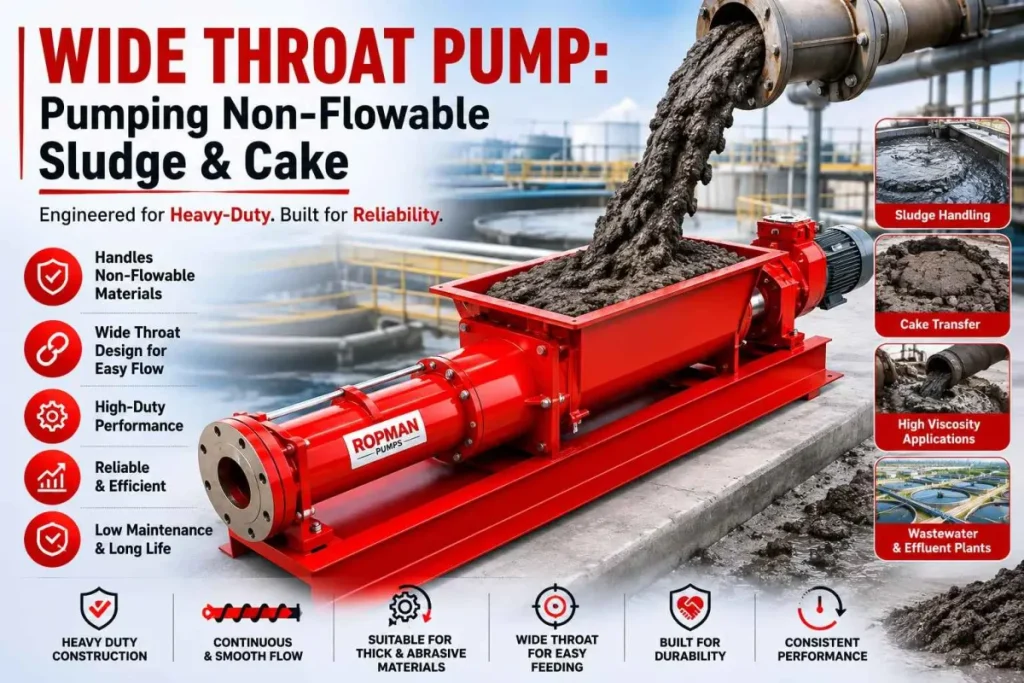
Dewatered cake does not flow. In larger plants it is conveyed or pumped to storage or trucks. A wide throat pump with a large hopper and auger feed forces this non-flowable cake into the pumping element where ordinary pumps fail.
8. Chemical Dosing Pumps
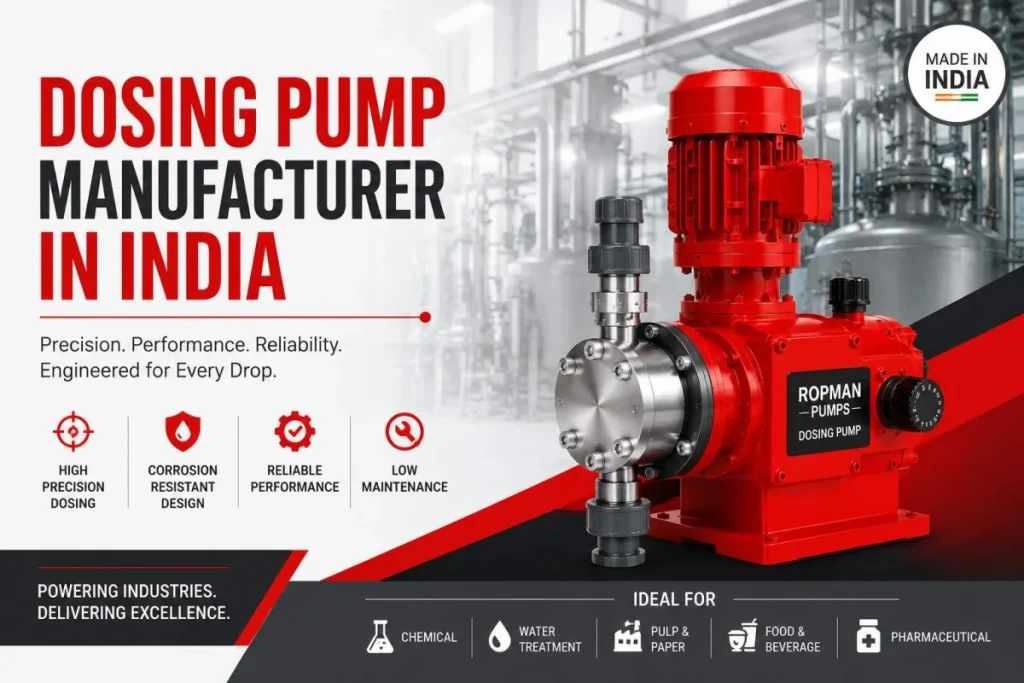
An STP doses several chemicals: sodium hypochlorite for disinfection, polymer for sludge dewatering, and sometimes alum, ferric or lime for phosphorus removal or pH control. Dosing pumps deliver small, accurate flows that can be adjusted to match the sewage flow.
9. Filter Feed, Backwash and Treated Water Pumps
Clean, clarified water is pumped through pressure sand and activated carbon filters with centrifugal pumps, which also handle backwashing. Treated water transfer pumps then send water to flushing tanks, gardens or cooling towers.
STP Pump System Selection Table
| Duty | Media | Typical Pump Type |
|---|---|---|
| Raw sewage lift | Sewage with solids and fibres | Non-clog submersible pump |
| Equalization transfer | Screened sewage | Submersible or non-clog pump |
| RAS / WAS | Activated sludge | Progressive cavity pump with VFD |
| Thickened / digested sludge | Viscous, high-solids sludge | Progressive cavity pump |
| Filter press feed | Conditioned sludge at rising pressure | Progressive cavity pump (single or multistage) |
| Dewatered cake | Non-flowable cake | Wide throat / hopper pump |
| Chlorine, polymer, alum, lime | Chemicals | Dosing pump |
| Filter feed, backwash, treated water | Clarified water | Centrifugal pump |
Clean water can tolerate a compromise pump. Sludge never does. Match the pump to the media, not to the price list.
Why Progressive Cavity Pumps Dominate Sludge Duties
A progressive cavity pump uses a single helical rotor turning inside a double-helix elastomer stator. The cavities between them move steadily from suction to discharge, carrying the media with very little shear or pulsation.
Handles High Solids
Thick sludge with grit, fibre and rags passes without clogging.
Flow Proportional to Speed
Easy, accurate control with a VFD for RAS, WAS and press feed.
Gentle on Floc
Low shear protects conditioned sludge before dewatering.
Self-Priming
Reliable restarts for intermittent duties like sludge wasting.
Learn more about the pumping element in our article on the rotor and stator, or our complete progressive cavity pump guide.
How to Size an STP Pump System
Information needed for each pump:
- Media type and stage (raw sewage, RAS, WAS, thickened sludge, cake, chemical)
- Required flow rate, average and maximum
- Total head or discharge pressure, including pipe losses
- Solids percentage, grit and fibre content
- Viscosity and temperature for sludge duties
- Chemical compatibility for dosing and elastomers
- Operating hours per day and working/standby arrangement
- Control method: level switches, timers, VFD or PLC
For a wider view of plant sizing, see our sewage treatment plant design guide.
Keeping the STP Pump System Reliable
- Install working and standby pumps on every critical duty.
- Fit dry-run protection and pressure relief on progressive cavity pumps.
- Use good screening to protect pumps from rags and plastics.
- Rotate pumps weekly so standby units stay ready.
- Keep stators, rotors, seals and joints in stock from the original manufacturer.
- Log flow, pressure and running hours to spot wear early.
Our STP maintenance checklist includes a full pump maintenance routine.
STP Pumps from Ropman
Ropman Engineering Corporation manufactures progressive cavity pumps, hopper type PC pumps, wide throat pumps and dosing pumps for sewage treatment plants at our facility in Meerut, India. Rotors and stators are produced in-house, so spares are correctly matched and quickly available. Explore our sewage treatment plant pumps and wastewater, ETP and STP solutions.
Progressive Cavity vs Centrifugal Pumps for Sludge
A frequent question when building an STP pump system is whether a cheaper centrifugal pump can handle sludge. For thin, dilute flows it sometimes can, but as solids rise the differences become decisive.
| Factor | Progressive Cavity Pump | Centrifugal Pump |
|---|---|---|
| Thick sludge | Handles high solids and viscosity well | Efficiency falls sharply as viscosity rises |
| Flow control | Flow proportional to speed, ideal with VFD | Flow changes with pressure; harder to control |
| Shear on floc | Low shear, protects conditioned sludge | High shear can break flocs before dewatering |
| Rising pressure (filter press) | Keeps delivering steady flow | Flow drops as pressure builds |
| Self-priming | Yes | Usually needs flooded suction |
| Clear water duties | Not needed | Efficient and economical |
The practical answer is to use both: centrifugal pumps for clear and screened water, and positive displacement pumps wherever the media is thick, variable or pressure-sensitive.
Sizing Example: Filter Press Feed Pump
Consider a 200 KLD plant producing waste sludge that is thickened in a holding tank. The operator wants to dewater one batch per shift in a filter press.
- Sludge volume per batch: estimated from daily sludge production and solids concentration in the holding tank.
- Filling time: the time allowed to fill the press, which sets the required flow rate.
- Final pressure: the maximum pressure the press operates at as the cake forms, which sets the pump pressure rating and number of stages.
- Solids and viscosity: conditioned sludge with polymer behaves differently from raw sludge, so the pump speed is kept moderate to limit wear and shear.
- Control: a VFD starts the pump fast to fill the press, then slows as pressure rises, with a pressure switch to stop at the set point.
- Protection: dry-run sensor, pressure relief and a flushing connection for cleaning.
Share these details with your pump supplier, and they can recommend the correct pump size, stages, speed and stator material.
Troubleshooting Common STP Pump Problems
| Problem | Likely Cause | What to Do |
|---|---|---|
| Raw sewage pump tripping | Rags or wipes jamming the impeller | Clean the impeller, improve screening, consider a cutter or vortex design |
| Sludge pump flow dropping | Worn stator or rotor, partly blocked suction | Check suction line, inspect wear parts, compare flow to speed |
| Sludge pump stator burnt | Dry running | Fit dry-run protection, check tank level control |
| Discharge pressure too high | Closed valve, blocked line, thickened sludge | Check valves, flush the line, fit pressure protection |
| Dosing pump not delivering | Air lock, worn diaphragm, blocked foot valve | Prime the pump, replace diaphragm, clean valves |
| Treated water pump cavitating | Low tank level, suction restriction | Check level controls, clean suction strainer |
Saving Energy in the STP Pump System
- Use VFDs on sludge and transfer pumps so they run only as fast as the process needs.
- Size pumps close to the real duty instead of adding large safety margins.
- Keep pipelines short and avoid unnecessary bends and valves.
- Replace worn wear parts promptly, because a worn pump uses more power for the same flow.
- Use timers or level controls so transfer pumps do not run against closed valves or empty tanks.
- Choose high-efficiency motors for pumps that run around the clock.
Buying Checklist for STP Pumps
Before you place an order:
- Describe the media honestly: solids percentage, grit, fibre, viscosity and temperature
- Give the real flow and total head, including pipe losses
- Specify the operating hours and the working and standby arrangement
- Confirm material of construction and elastomer compatibility
- Ask for the pump curve or performance data at your duty point
- Check delivery time and availability of spare parts
- Ask about service support and commissioning help
- Compare total cost of ownership, not only the purchase price
A well-specified STP pump system is one of the best investments in plant reliability. Pumps chosen for the actual media run for years with routine care, while mismatched pumps become a constant source of breakdowns. For budgeting, see our sewage treatment plant cost guide, and for routine care, our STP maintenance checklist.
Frequently Asked Questions
Which pumps are used in an STP?
Which is the best pump for STP sludge?
What pump is used for filter press feed in an STP?
What is a RAS pump in an STP?
How many pumps does an STP need?
Can a centrifugal pump be used for STP sludge?
Why does an STP sludge pump lose flow over time?
How can I reduce energy use in STP pumps?
Build a Reliable STP Pump System
Ropman manufactures progressive cavity, wide throat, hopper and dosing pumps for every sludge and chemical duty in an STP. Share your duties and we will size the right pumps.
Request a Quote