
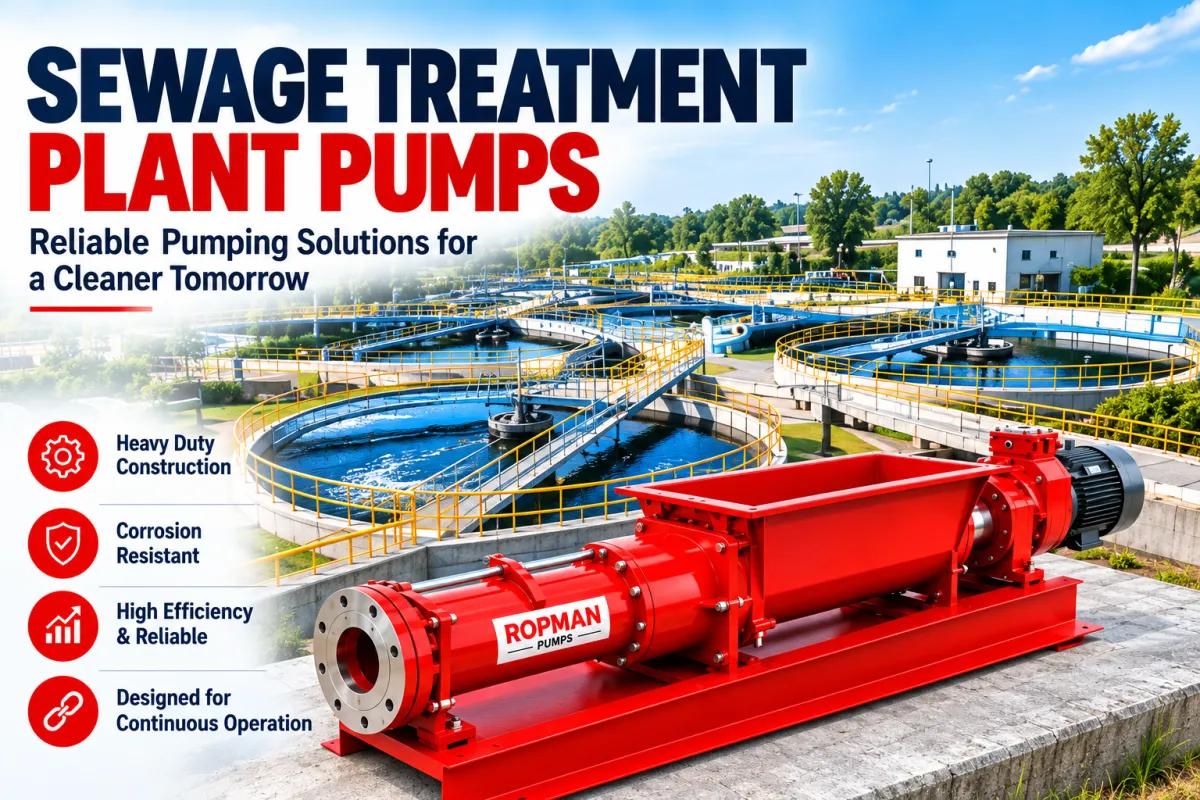
Sewage Treatment Plant Cost in India: Price Guide
What drives STP pricing, indicative costs by capacity, and how to plan running costs before you buy.
Quick Answer
The sewage treatment plant cost in India depends mainly on capacity (in KLD), technology, treated water quality and civil work. As an indicative 2026 range, a small 10–25 KLD packaged STP may cost around ₹3–10 lakh, a 100 KLD plant around ₹15–30 lakh, and a 1 MLD plant ₹1–2.5 crore or more. Running costs for power, operators, chemicals and maintenance must be budgeted separately.
On This Page
- What Decides Sewage Treatment Plant Cost?
- Indicative Sewage Treatment Plant Cost by Capacity
- Understanding STP Cost per KLD
- Operating Cost: The Part Buyers Forget
- 7 Ways to Reduce Total Sewage Treatment Plant Cost
- How to Get an Accurate STP Quote
- How Pump Choice Affects Lifetime Cost
- Where the Money Goes: A Typical Cost Breakdown
- Worked Example: Budgeting a 100 KLD STP
- Hidden Costs Buyers Often Miss
- New Plant vs Upgrading an Existing STP
- How to Compare STP Quotations Fairly
- Frequently Asked Questions
If you are planning a new building, expanding a factory township or replacing an old plant, one of the first questions is the sewage treatment plant cost. The honest answer is that it varies widely, but the factors behind the price are predictable. Once you understand them, you can compare quotes properly and avoid paying twice: once at purchase and again in breakdowns.
This guide explains what drives STP pricing in India, gives indicative cost ranges by capacity, breaks down running costs, and shares practical ways to keep the total cost of ownership low.
What Decides Sewage Treatment Plant Cost?
Two STPs with the same capacity can differ in price by 50% or more. These are the factors that create the difference.
1. Capacity (KLD or MLD)
Capacity is measured in kilolitres per day (KLD) or million litres per day (MLD). It is the single biggest driver of cost. The larger the plant, the higher the total price, but the lower the cost per KLD because tanks, blowers and controls scale efficiently. If you are unsure how to size a plant, our STP design guide explains the calculation.
2. Treatment Technology
Conventional activated sludge and extended aeration plants are usually the cheapest to build where land is available. MBBR and SBR cost more in equipment but save space. MBR plants cost the most because of the membranes, but deliver reuse-quality water. Our MBBR vs SBR vs MBR comparison covers the trade-offs.
3. Treated Water Quality
Meeting basic discharge norms is cheaper than producing water for flushing, cooling towers or landscaping. Adding pressure sand filters, activated carbon filters, UV or ultrafiltration raises the price. Stricter local norms, explained in our article on CPCB STP norms, can also push up cost.
4. Civil Construction vs Prefabricated Tanks
RCC tanks built on site involve excavation, concrete and waterproofing. Prefabricated FRP, MS or containerised units cost more per unit of volume but install faster with less site work. See our guide to packaged STPs for when they make sense.
5. Equipment Quality
Blowers, pumps, diffusers, media and control panels vary greatly in quality. Cheaper equipment can lower the quote by a few lakh rupees but raise maintenance costs for the next 15 years.
6. Sludge Handling and Automation
A filter press or screw press, sludge pumps, polymer dosing, PLC automation and online monitoring all add to cost, but reduce manual work and odour.
7. Site Conditions
High groundwater, rocky soil, limited access, basement installations and long pipe runs all increase installation cost.
Indicative Sewage Treatment Plant Cost by Capacity
The table below gives budgetary ranges for complete MBBR or SBR type plants in India, including equipment, installation and typical civil work. Use it for early planning only.
| Capacity | Typical Use | Indicative Cost Range |
|---|---|---|
| 10–25 KLD | Small offices, villas, small schools | ₹3 lakh – ₹10 lakh |
| 50 KLD | Apartments of about 100 flats, small hotels | ₹8 lakh – ₹18 lakh |
| 100 KLD | Large housing societies, hospitals | ₹15 lakh – ₹30 lakh |
| 250–500 KLD | Townships, campuses, IT parks | ₹40 lakh – ₹1 crore |
| 1 MLD (1,000 KLD) | Large townships, small towns | ₹1 crore – ₹2.5 crore+ |
| 10 MLD and above | Municipal plants | Project-specific (tendered) |
Note: These are indicative market ranges, not quotations. Actual sewage treatment plant cost depends on technology, inlet load, outlet norms, civil scope, location and current material prices. Always get two or three detailed quotes based on the same specification.
Understanding STP Cost per KLD
Many buyers compare quotes using cost per KLD. A small 20 KLD plant can easily cost ₹25,000–₹40,000 per KLD, while a 500 KLD plant may come in well below ₹15,000 per KLD. The reason is that controls, panels, engineering, and minimum equipment sizes are similar regardless of capacity.
Cost per KLD is useful, but only when quotes cover the same scope. One quote may include the filter press, tertiary filters and civil work, while another does not. Always compare a line-by-line scope of supply.
Operating Cost: The Part Buyers Forget
The purchase price is only the start. Over 10–15 years, running costs often exceed the capital cost. Budget for these items from day one.
Electricity
Air blowers are the biggest power consumers, followed by pumps. Efficient blowers and correct aeration control make a large difference.
Operator Salaries
Most plants need trained operators on shifts. Remote monitoring can reduce staffing for small plants.
Chemicals
Chlorine for disinfection, polymer for dewatering, and sometimes alum or lime. Accurate dosing pumps prevent waste.
Maintenance and Spares
Diffusers, filter media, pump wear parts, blower belts and oil. Easy spare availability keeps downtime low.
Sludge Disposal
Dewatered sludge must be removed regularly. Better dewatering means less weight to transport.
Testing and Compliance
Periodic lab testing and pollution control board consent renewal fees.
As a rough guide, a well-run 100 KLD residential STP may cost somewhere in the range of ₹40,000–₹90,000 per month to operate, depending on power tariff, staffing and treated water reuse. Our STP maintenance checklist shows how good routine care keeps these costs down.
7 Ways to Reduce Total Sewage Treatment Plant Cost
- Size the plant correctly. Oversizing wastes capital; undersizing causes failures and penalties.
- Choose technology for your site, not for the brochure. Use land where you have it; go compact only where you must.
- Reuse treated water. Flushing and gardening reuse can save more on water bills than the plant costs to run.
- Invest in efficient blowers and VFDs to cut the largest power expense.
- Use the right pump for each duty. A progressive cavity pump for sludge avoids clogging and repeated repairs.
- Dose chemicals accurately with reliable dosing pumps rather than manual addition.
- Plan for spares and service from local manufacturers to avoid long downtime.
The cheapest STP quote is rarely the cheapest STP. Total cost of ownership over 15 years is the number that matters.
How to Get an Accurate STP Quote
Share the following details with suppliers so their quotes are comparable:
Information to include in your STP enquiry:
- Number of users or flats, and type of building
- Average daily sewage flow and peak flow, if known
- Raw sewage characteristics (BOD, COD, TSS) or a lab report
- Required treated water quality and intended reuse
- Available area, depth limits and site photos
- Whether civil work is in the supplier’s scope
- Sludge handling expectations and automation level
- Applicable state pollution control board norms
How Pump Choice Affects Lifetime Cost
Pumps are a small share of the capital cost of a sewage treatment plant, but they have a big effect on reliability. Raw sewage, return sludge and sludge transfer pumps run every day, often around the clock. A poorly chosen sludge pump clogs, loses efficiency and needs constant attention.
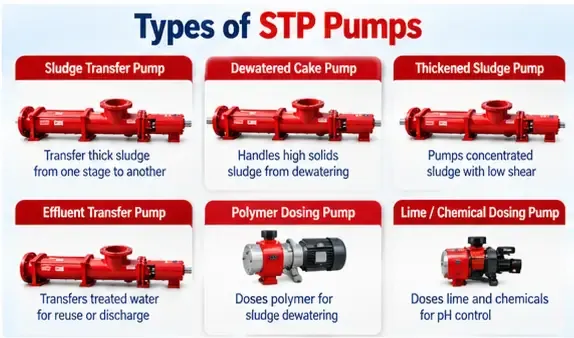
Ropman Engineering Corporation manufactures progressive cavity, wide throat and dosing pumps for STPs in Meerut, with in-house rotors and stators for fast, correctly matched spares. For a full breakdown of every pumping duty, see our STP pump system guide, or the background on sewage treatment.
Where the Money Goes: A Typical Cost Breakdown
When you look at a detailed quotation, the sewage treatment plant cost splits into a few major blocks. The exact share varies by project, but this indicative breakdown for a mid-sized MBBR plant with RCC tanks helps you read a quote critically.
| Cost Head | What It Covers | Indicative Share |
|---|---|---|
| Civil works | Excavation, RCC tanks, waterproofing, covers, operator room | 30–45% |
| Mechanical equipment | Blowers, pumps, diffusers, MBBR media, screens, filters | 25–35% |
| Sludge handling | Sludge pumps, filter press or screw press, polymer dosing | 8–15% |
| Electrical and automation | Panels, cabling, PLC, instruments, flow meters | 8–12% |
| Piping and valves | Process piping, air headers, valves and fittings | 5–10% |
| Engineering and commissioning | Process design, drawings, start-up, operator training | 3–8% |
If one quote is far lower than the others, check which of these blocks has shrunk. Very often the difference lies in civil scope, sludge handling or the quality of blowers and pumps rather than in genuine efficiency.
Worked Example: Budgeting a 100 KLD STP
Consider a residential project of about 200 flats needing a 100 KLD plant with tertiary treatment for flushing reuse. A realistic early budget might look like this:
- Capital cost: about ₹15–30 lakh for a complete MBBR plant, depending on civil scope and equipment brands.
- Monthly power: blowers, pumps and filters typically drive the largest running expense; the exact figure depends on your tariff and how well aeration is controlled.
- Monthly manpower: one or two trained operators or an O&M contract.
- Chemicals and consumables: hypochlorite, polymer, lab tests and filter media replacement spread over the year.
- Savings: if 60–70% of the treated water replaces purchased water for flushing and gardening, the savings can offset a large part of the running cost, especially where tanker water is expensive.
The lesson is simple: look at the sewage treatment plant cost over 10–15 years, not just on the day of purchase. A plant that costs a little more but saves power and avoids breakdowns usually wins.
Hidden Costs Buyers Often Miss
- Consent fees: consent to establish and operate from the State Pollution Control Board, plus renewals.
- Dual plumbing: separate pipelines for treated water reuse, which are expensive to add later.
- Treated water storage: tanks and transfer pumps to send water to flushing tanks and gardens.
- Odour and noise control: covers, ventilation and acoustic enclosures near residences.
- Power backup: DG set capacity to keep blowers running during outages.
- Sludge transport: regular removal of dewatered cake to an approved site.
- Lab testing: periodic analysis at an approved laboratory.
- Spares inventory: diffusers, pump wear parts, belts and filter media.
New Plant vs Upgrading an Existing STP
Many older plants fail to meet today’s norms or cannot handle increased occupancy. Before budgeting for a completely new plant, check whether an upgrade is possible. Adding MBBR media to an existing aeration tank, replacing old blowers with efficient ones, adding tube settlers, installing tertiary filters or replacing clog-prone sludge pumps can restore performance at a fraction of the sewage treatment plant cost of a new build.
Upgrade Makes Sense When
- Civil tanks are structurally sound
- Capacity needs to grow moderately
- Problems trace to equipment or operation
New Plant Makes Sense When
- Tanks are leaking or corroded
- Capacity must double or more
- Norms require a different technology
How to Compare STP Quotations Fairly
Before you sign, confirm that every quote:
- Is designed for the same capacity, peak flow and inlet quality
- Guarantees the same treated water parameters in writing
- Lists equipment makes, models and quantities, including standby units
- States clearly what civil, electrical and piping work is included
- Includes sludge handling and dewatering, or says it does not
- Shows connected and running power load
- Includes commissioning, trial run and operator training
- Defines warranty, AMC terms and spares pricing
Asking these questions turns a confusing set of numbers into a fair comparison and protects you from a plant that looks cheap but costs more to own.
Frequently Asked Questions
What is the cost of a sewage treatment plant in India?
What is the STP cost per KLD?
What is the running cost of an STP plant?
Which STP technology is cheapest?
How can I reduce my STP cost?
What share of STP cost is civil work?
Is it cheaper to upgrade an old STP than build a new one?
Does treated water reuse reduce STP running cost?
Planning an STP? Get the Pumps Right
Tell us your plant capacity and sludge duties, and Ropman will recommend progressive cavity, wide throat and dosing pumps that keep running costs low.
Request a Quote