
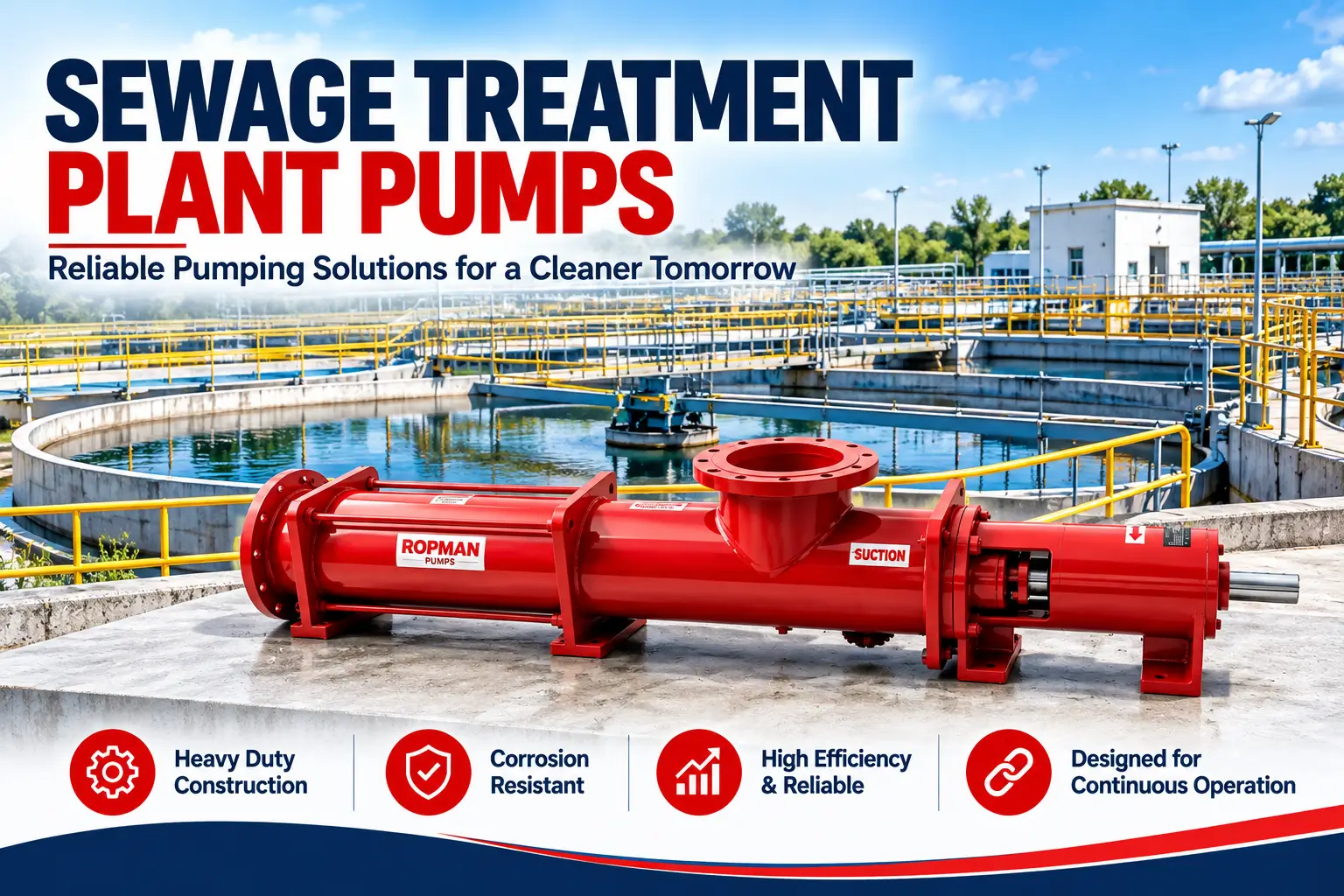
Sewage Treatment Plant Pumps
Reliable pumps for every sludge, effluent, and dosing duty in a modern STP — engineered and built in-house by Ropman.
Quick Answer
Sewage treatment plant pumps move raw sewage, sludge, effluent, and treatment chemicals through every stage of an STP. The toughest duties — raw sludge, thickened and digested sludge, dewatered cake, and polymer dosing — are handled by progressive cavity, wide throat, and dosing pumps, because they move thick, abrasive, solids-laden media gently and accurately where other pumps clog or wear out.
On This Page
Sewage treatment plant pumps are the workhorses of every STP. From the moment raw sewage arrives to the final discharge of treated effluent, pumps move the flow, transfer the sludge, and dose the chemicals that make treatment possible. Choose them well and the plant runs smoothly for years; choose badly and you face constant clogging, wear, and downtime.
Ropman Engineering Corporation specialises in the hardest of these duties — the thick, abrasive, solids-laden sludge streams that defeat ordinary pumps. This page explains where each pump fits in an STP and how to select the right one. For an overview of the process itself, see this reference on sewage treatment.
Why Sewage Treatment Plant Pumps Are Demanding
Sewage treatment plant pumps face conditions few other pumps have to survive. The media changes constantly, carries solids and grit, and often has to be dosed with pinpoint accuracy. A pump that is fine on clean water can fail within weeks on sludge.
- High and variable solids — from screenings to thick dewatered cake.
- Abrasive grit and sand that grind away at wetted parts.
- Fibrous, stringy material that clogs impeller-based pumps.
- Corrosive and septic conditions that attack the wrong materials.
- Accurate dosing needs for polymer, lime, and other chemicals.
- Round-the-clock running where downtime is not an option.
An STP never stops. That is why sewage treatment plant pumps must be chosen for reliability first — a pump that clogs at 2 a.m. costs far more than the pump itself.
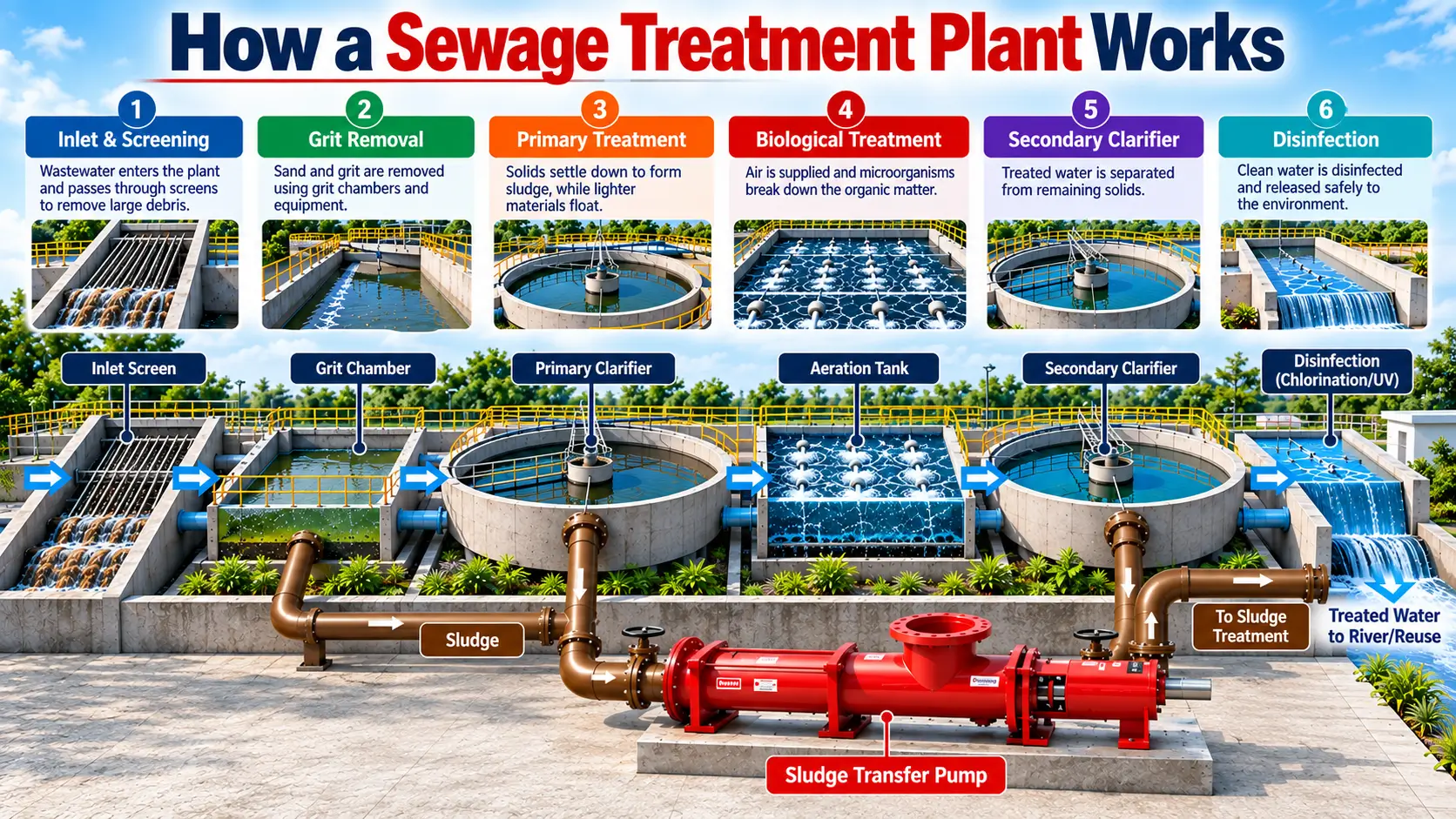
Pump Duties Across the STP Stages
Each stage of an STP needs a pump matched to its specific media. This is where the right sewage treatment plant pumps make the difference between smooth operation and constant maintenance.
| STP Stage | Media | Suitable Pump |
|---|---|---|
| Inlet & raw sewage | Screened sewage, grit | Non-clog / progressive cavity |
| Primary sludge transfer | Raw settled sludge | Progressive cavity pump |
| RAS / WAS | Activated sludge | Progressive cavity pump |
| Thickened sludge | Thick, viscous sludge | Progressive cavity pump |
| Dewatered cake | Non-flowable cake | Wide throat pump |
| Polymer & lime dosing | Chemicals | Dosing pump |
| Digested sludge | Digester output | Progressive cavity pump |
6 Essential Sewage Treatment Plant Pumps
Across a full STP, six pump duties cover almost everything. Ropman builds sewage treatment plant pumps for each of them.
1. Raw & Primary Sludge Pumps
Progressive cavity pumps move settled raw sludge gently and reliably, handling the solids and grit that clog other designs.
2. RAS / WAS Pumps
Return and waste activated sludge must be moved at controlled, steady rates — ideal for progressive cavity pumps with VFD control.
3. Thickened Sludge Pumps
As sludge thickens, viscosity rises. Progressive cavity pumps actually improve in efficiency as the media gets thicker.
4. Dewatered Cake Pumps
Non-flowable cake from the dewatering stage needs a wide throat pump with an auger feed to force it into the pumping element.
5. Polymer & Lime Dosing Pumps
Accurate, non-pulsating dosing pumps deliver polymer and lime precisely, cutting chemical waste and improving treatment.
6. Digested Sludge Pumps
Progressive cavity pumps transfer digested sludge from digesters to dewatering or storage without clogging or shearing.
Why Progressive Cavity Pumps Suit STP Sludge
Most of the hardest sewage treatment plant pumps duties are handled by the progressive cavity pump. As a positive displacement pump, it moves media in sealed cavities — exactly what sludge demands.
- Handles high solids and fibre without clogging.
- Efficiency rises with viscosity — thick sludge pumps cleanly.
- Gentle, low-shear flow that does not break up floc.
- Steady, non-pulsating output for accurate transfer and dosing.
- Flow proportional to speed for precise VFD control.
- Self-priming and able to run in reverse to clear a line.
How to Select the Right Sewage Treatment Plant Pump
Choosing sewage treatment plant pumps correctly comes down to describing the media and duty honestly. This checklist covers the essentials.
STP pump selection checklist:
- Identify the stage and media — raw, RAS/WAS, thickened, cake, or digested.
- Measure solids percentage and check for grit and fibre.
- Define flow rate and discharge pressure with real pipe losses.
- Match the stator elastomer to the media and temperature.
- Specify a wide throat for non-flowable cake.
- Add dry-run protection and a pressure relief valve.
- Plan for spares — in-house rotors and stators mean fast replacement.
Why Choose Ropman for Sewage Treatment Plant Pumps
Ropman Engineering Corporation manufactures sewage treatment plant pumps — progressive cavity, wide throat, and dosing pumps — at its facility in Meerut, India, with rotors and stators produced in-house. That means correctly matched wet-end parts, fast spares when a pump is down, and pumps sized for your exact sludge rather than a generic catalogue.
Explore our progressive cavity pump range, our dosing pumps, and our dedicated wastewater treatment solutions to see how we support sewage treatment plant pumps across India. To discuss a project, contact our team.
Frequently Asked Questions
Which pumps are used in a sewage treatment plant?
Why are progressive cavity pumps preferred in STPs?
What pump handles dewatered sludge cake?
How are chemicals dosed in a sewage treatment plant?
Does Ropman manufacture sewage treatment plant pumps in India?
Building or Upgrading an STP? Talk to Ropman.
Tell us your stage, media, solids content, and flow, and our engineers will size the right sewage treatment plant pumps for your project.
Request a Quote