
Multistage Progressive Cavity Pump: How 24 Bar Is Actually Built
A multistage progressive cavity pump reaches 24 bar not by pushing harder at one point, but by dividing the job across several sealed stages in series — each one adding a manageable slice of pressure until the total reaches the duty you need. Understanding that difference is the key to specifying a 24 bar pump that survives its first year instead of failing in month three.
This guide explains what a stage actually is, how staging builds pressure, why 24 bar is a common industrial sweet spot, and — most importantly — the trade-offs and de-rating rules that catalogue pages tend to leave out.
- In a multistage progressive cavity pump, one stage equals a full stator pitch length and typically adds around 6 bar.
- 24 bar therefore usually means a four-stage pump — a longer rotor and stator assembly.
- Pressure builds incrementally along the pump, not all at once at the outlet.
- Solids, abrasives, and temperature de-rate the safe pressure per stage.
- Higher pressure means more torque, more heat, and a longer pump — plan for all three.
- A pressure relief valve is mandatory on any positive displacement pump.
What Is a Multistage Progressive Cavity Pump?
A multistage progressive cavity pump is a single screw pump whose rotor and stator assembly contains more than one complete pitch length, allowing it to generate proportionally higher discharge pressure than a single-stage unit of the same diameter.
One stage is defined as the complete pitch length of the stator, which corresponds to two rotor pitches. Add a second stage and you roughly double the pressure capability. Add four and you reach the 24 bar class. The flow rate does not change with staging — only the pressure does. Flow is set by rotor geometry and speed; pressure is set by length.
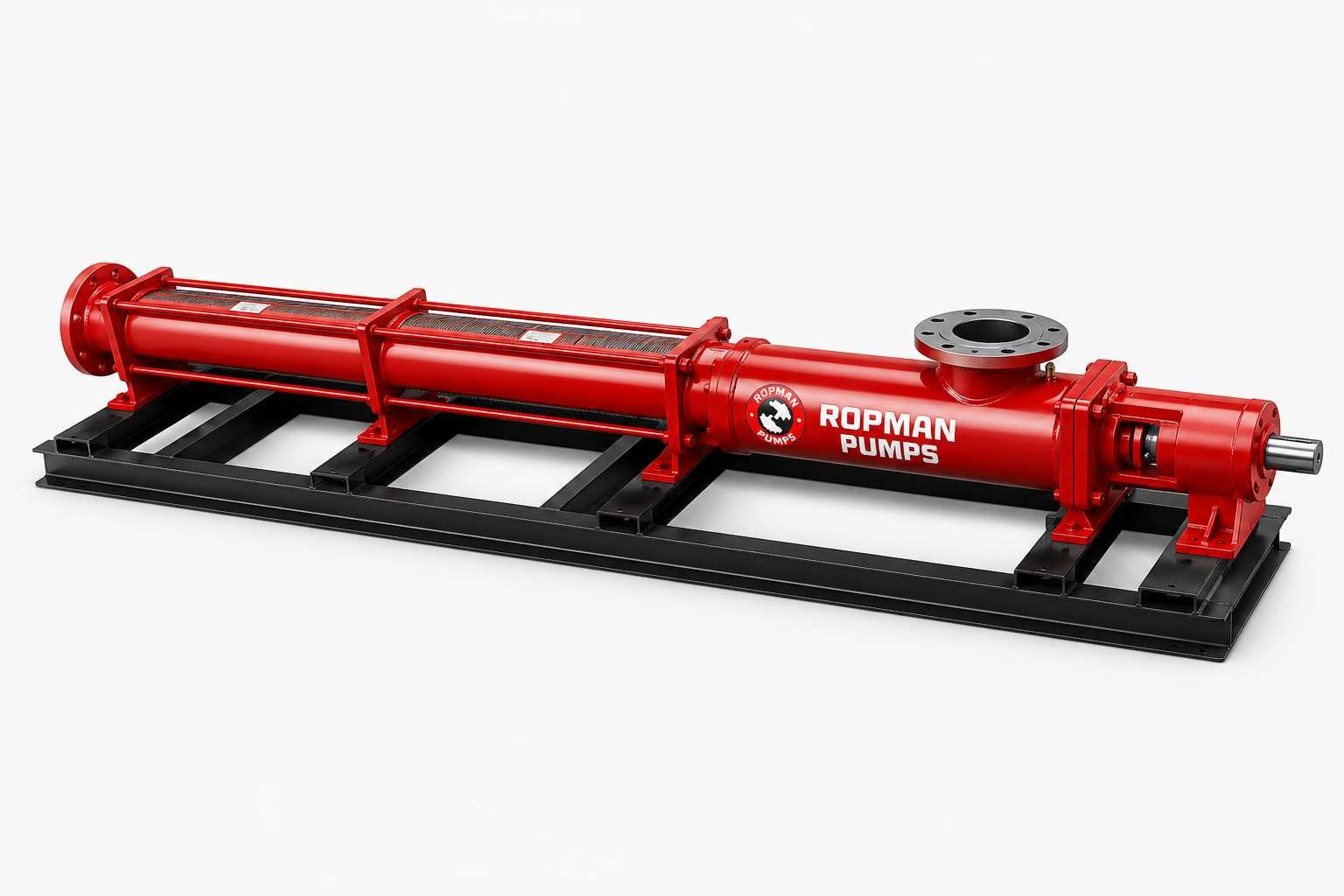
How a Multistage Progressive Cavity Pump Builds 24 Bar
Pressure inside a multistage progressive cavity pump is not generated at a single point. It is distributed incrementally along the rotor–stator assembly: each sealed cavity carries a small pressure rise, and the total differential pressure is the sum of every stage in the chain.
The industry convention is roughly 6 bar of differential pressure per stage. Working from that figure gives the familiar product tiers:
Indicative only — exact staging depends on geometry, elastomer, and duty.
The 6 bar per stage figure is an engineering convention, not a law of physics. There is no fundamental reason a stage must stop at 6 bar — generally, the longer the rotor and stator assembly, the higher the achievable pressure. Rigid metal stators handling clean, viscous, non-abrasive fluids can go considerably higher per stage. What the convention really encodes is a sensible balance between pressure, sealing, heat, and stator life for typical elastomer pumps.
Why 24 Bar Is the Multistage Progressive Cavity Pump Sweet Spot
A 24 bar multistage progressive cavity pump sits at a useful point on the curve: high enough to overcome serious system resistance, but still compact and economical compared with an eight-stage machine. It is typically specified when:
- Long pipe runs create heavy friction losses with viscous media.
- A filter press must be fed against rising cake resistance.
- Grout or cement slurry has to be injected into ground or structures.
- Chemicals must be injected into a pressurised line or vessel.
- Dewatered sludge or cake has to be pushed to a distant silo or dryer.
The Trade-offs Nobody Puts in the Brochure
Choosing a multistage progressive cavity pump is not simply “more stages, more pressure, done”. Every added stage has consequences that show up in the plant, not on the datasheet.
De-rating: Why a 24 Bar Pump May Not Give You 24 Bar
This is the point that causes most disappointment on site. The rated pressure of a multistage progressive cavity pump assumes a reasonably benign fluid. Change the fluid and the safe pressure per stage falls.
| Condition | Effect on Pressure per Stage | Practical Response |
|---|---|---|
| High solids concentration | Reduced — sealing degrades and wear accelerates | Add stages, or accept lower duty pressure |
| Abrasive grit or sand | Reduced — rapid stator and rotor wear | Harder stator compound, coated rotor, slower speed |
| High process temperature | Reduced — elastomer softens and swells | Re-select elastomer for actual duty temperature |
| High viscosity, low abrasion | Often increased | Fewer stages may suffice for the same pressure |
| High running speed | Reduced effective life at rated pressure | Oversize the pump and run slower via VFD |
← Swipe the table sideways to see all columns
⚠️ Rule of thumb: the dirtier and hotter the fluid, the more conservatively you should stage. A pump specified at exactly 24 bar for a clean fluid may need extra stages — or a lower operating pressure — once real solids and real temperatures are involved.
Specifying a 24 Bar Multistage Progressive Cavity Pump: 6 Checks
Multistage Progressive Cavity Pump Safety: Relief Valves
Because a multistage progressive cavity pump is a positive displacement machine, it will attempt to deliver the same volume regardless of resistance, building internal pressure until it exceeds the system backpressure. Close the discharge on a 24 bar pump and it does not shrug and give up — it keeps pushing until the weakest component in the system fails.
At 24 bar that failure can be genuinely dangerous. A correctly sized pressure relief valve, piped back to suction or to a safe drain, is a mandatory part of the installation. Dry-run protection matters just as much: a stator starved of fluid can be destroyed within minutes.
Troubleshooting a Multistage Progressive Cavity Pump
| Symptom | Likely Cause | Action |
|---|---|---|
| Cannot reach rated pressure | Stator wear increasing internal slip | Check rotor/stator fit; replace worn elements |
| Motor trips on start-up | Start-up torque underestimated | Review drive sizing; consider soft start or VFD ramp |
| Stator hardened or blistered | Excess heat from over-pressuring or dry running | Reduce speed, re-select elastomer, fit dry-run protection |
| Flow falls as pressure rises | Slip increasing with differential pressure | Normal to a degree — if excessive, add a stage |
| Rapid joint or rod wear | Rotor deflection on a long assembly | Check alignment, supports, and joint condition |
← Swipe the table sideways to see all columns
Multistage vs Single-Stage: Quick Comparison
| Aspect | Single Stage (≈6 bar) | Multistage (≈24 bar) |
|---|---|---|
| Pressure capability | Low | High |
| Physical length | Compact | Noticeably longer |
| Torque required | Lower | Higher |
| Flow at same size | Same | Same |
| Typical duty | Transfer, feeding | Injection, filter press, long pipelines |
← Swipe the table sideways to see all columns
24 Bar Pumps, Engineered in Meerut
Ropman Engineering Corporation manufactures multistage progressive cavity pumps in 12, 24, and 36 bar classes — with rotors and stators produced in-house for correct staging, fast spares, and long service life. Send us your fluid, solids content, temperature, and required pressure, and we will stage the pump correctly the first time.
Request a Quote →Frequently Asked Questions
How many stages does a 24 bar progressive cavity pump need?
Typically four stages, based on the industry convention of roughly 6 bar of differential pressure per stage. The exact number depends on pump geometry, stator material, and how abrasive or solids-laden the fluid is.
What is a stage in a progressive cavity pump?
One stage is the complete pitch length of the stator, equal to two rotor pitches. Each stage contains sealed cavities that contribute an incremental pressure rise, so total pressure is the sum of all stages.
Does adding stages increase flow rate?
No. Staging increases pressure capability only. Flow rate is determined by rotor geometry, eccentricity, and rotational speed, so a four-stage pump delivers the same flow as a single-stage pump of the same size.
Is pressure capability affected by viscosity?
Pressure rating comes from staging rather than viscosity, but viscosity does affect efficiency. Thicker fluids seal internal clearances better and reduce slip, so a viscous fluid often performs better than a thin one at the same pressure.
Why does my 24 bar pump not reach 24 bar in service?
The most common causes are stator wear increasing internal slip, and de-rating from solids, abrasives, or high temperature that reduce the safe pressure each stage can deliver. Worn elements and optimistic fluid data explain most shortfalls.
Does a 24 bar pump need a pressure relief valve?
Yes, always. As a positive displacement machine it will keep building pressure against a closed discharge until something fails. A correctly sized relief valve is a mandatory safety device at this pressure class.
- Progressive Cavity Pumps — full product range
- Dosing Pumps for chemical injection duties
- Contact Ropman — get your pump staged correctly
↑ Replace these with your exact live URLs before publishing.
Further background: progressing cavity pump overview and a technical primer from Pumps & Systems magazine.