
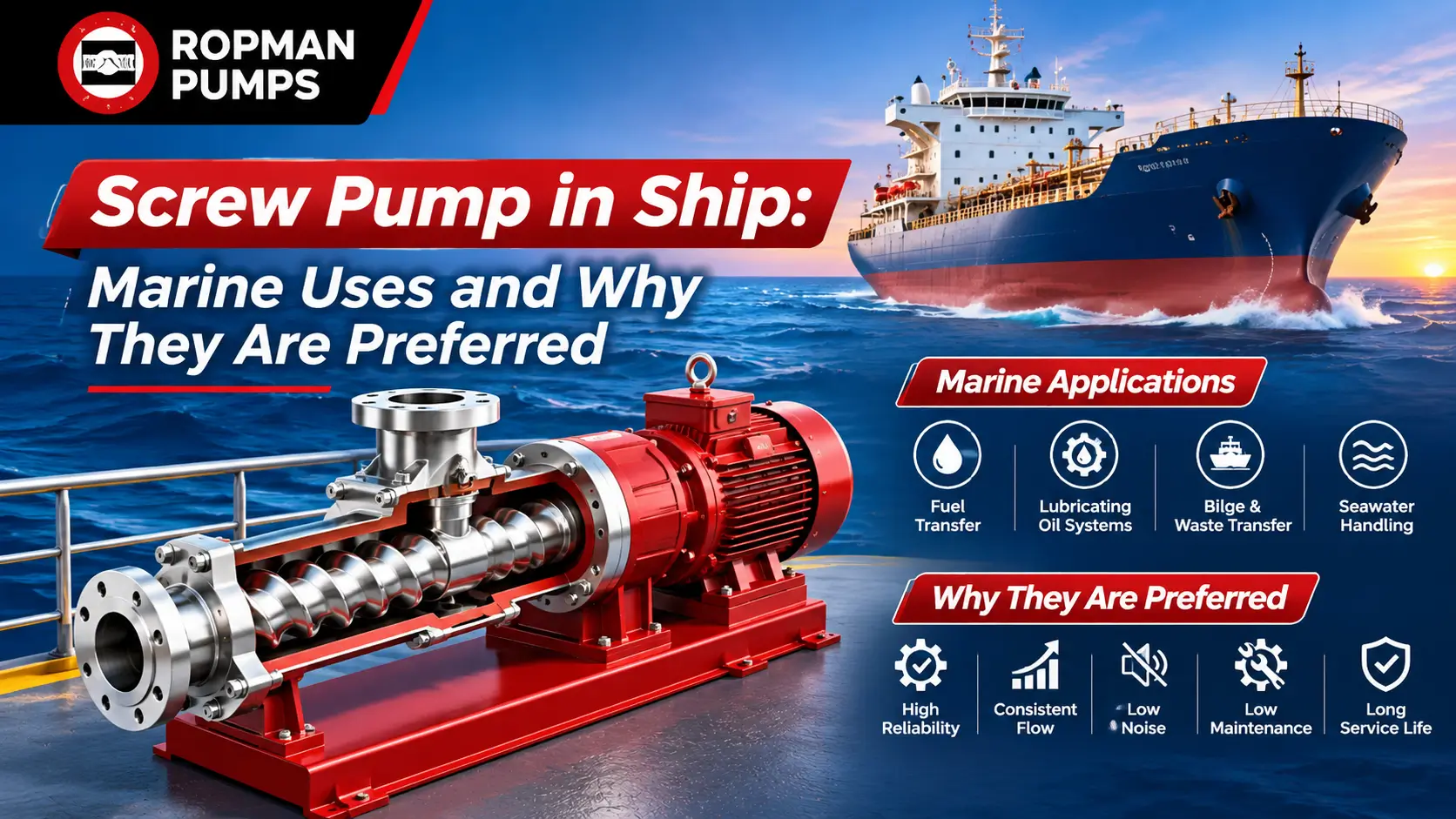
A screw pump in a ship is one of those machines most crew never think about until it stops. It moves fuel oil, lube oil, hydraulic oil and cargo day after day, quietly and with little pulsation. This guide explains where a screw pump in a ship is used, why marine engineers prefer it for oils, and what to check when you select one.

Where Is a Screw Pump Used in a Ship?
Marine screw pumps are positive displacement pumps, usually with two or three screws that mesh inside a casing. The common duties are:
- Fuel oil transfer and booster service: moving heavy fuel and diesel from tanks to settling, service and engine systems.
- Lubricating oil circulation: feeding main engine and gearbox bearings with steady pressure.
- Hydraulic power packs: deck cranes, winches, steering and stabiliser systems.
- Cargo and stripping pumps on tankers: discharging oil and cleaning tanks.
- Sludge and bilge oil handling: thick, dirty oily mixtures.
Why Ships Use a Screw Pump for Oil
- Handles viscosity. Heavy fuel oil is thick, especially when cold. A screw pump keeps delivering rated flow, where a centrifugal pump would lose performance.
- Smooth, low pulsation flow. That protects pipework and instruments, and keeps noise down.
- Self-priming. It can pull oil from tanks below the pump.
- Steady pressure. Flow barely changes as system pressure moves.
- Compact. Important when every square metre of engine room counts.
If you want a side-by-side view, read screw pump vs centrifugal pump. For the working principle of the type, see screw pump.
Types of Marine Screw Pumps
| Type | How it works | Typical marine use |
|---|---|---|
| Twin screw | Two meshing screws, timed by gears | Fuel oil, cargo, high-flow oil |
| Triple screw | One power screw drives two idler screws | Lube oil, hydraulic, clean oils |
| Progressive cavity | Single rotor in an elastomer stator | Sludge, bilge oil, viscous waste |
Clean oils suit the metal-to-metal designs. Dirty, abrasive or sludge-like liquids suit a progressive cavity design. Our breakdown of screw pump types explains the difference, and the progressive cavity pump guide covers the single-screw type.
What to Check When Selecting a Screw Pump for a Ship
- Fluid and temperature. Heavy fuel is pumped hot. Check seals and clearances for that heat.
- Viscosity range. From cold start to operating temperature.
- Flow and pressure. Include pipe runs, filters and heaters.
- Class approval. Marine equipment often needs approval from a classification society, so confirm requirements early.
- Materials. Seawater, vibration and corrosion matter on board.
- Protection. Relief valves, strainers and dry-run protection.
Common Problems With Marine Screw Pumps
- Dry running: damages screws or the stator quickly.
- Blocked suction strainers: cause cavitation and noise.
- Wear from dirty oil: reduces flow and pressure over time.
- Closed discharge valves: create dangerous pressure without a relief valve.
Good habits pay off. Check strainers, keep oil clean and watch pressure trends. Our tips on reducing progressive cavity pump maintenance cost apply to many positive displacement pumps.
FAQs: Screw Pump in Ship
Why is a screw pump used for fuel oil on ships?
It handles thick fuel smoothly, self-primes and delivers steady flow with little pulsation.
What is the difference between twin screw and triple screw pumps?
A twin screw pump uses two timed screws and suits larger, heavier duties. A triple screw pump uses one driven screw with two idlers and suits cleaner oils.
Can a screw pump handle oily sludge on board?
Yes. A progressive cavity pump is a common choice for thick oily sludge and bilge waste.
Looking for a Pump for Thick or Oily Liquids?
Share your fluid, temperature and flow with Ropman Pumps and we will recommend a suitable pump from our product range. Contact us to discuss your duty.
Key Takeaway on Screw pump in ship
Use this guide on screw pump in ship as a checklist before you request a quote. If your team is still unsure about screw pump in ship, share your fluid data with our engineers. Keep notes on screw pump in ship for every pump you install, so the next selection is faster. Good decisions on screw pump in ship come from real data, not rough estimates. Bookmark this page on screw pump in ship and return to it when your duty changes. Whenever screw pump in ship comes up in a project meeting, start with the fluid, flow and pressure.