
Packaged / Prefabricated STP: Benefits & Uses
Factory-built sewage treatment for sites that need fast installation and a small footprint.
Quick Answer
A packaged STP, also called a prefabricated STP, is a complete sewage treatment plant built in a factory inside FRP, steel or container-type tanks and delivered ready to connect. It usually uses MBBR, SBR or extended aeration technology and suits capacities from a few KLD to a few hundred KLD. Key benefits are faster installation, minimal civil work, a smaller footprint, and the ability to relocate or expand.
On This Page
- What Is a Packaged STP?
- How a Packaged STP Works
- 8 Benefits of a Prefabricated STP
- Limitations to Consider
- Where Packaged STPs Are Used
- How to Choose a Packaged STP
- Pumps for Packaged STPs
- Packaged STP vs Conventional Civil STP
- Installation Steps: From Order to Commissioning
- Choosing the Right Tank Material
- Maintaining a Compact Unit
- Mistakes to Avoid When Buying
- The Future of Decentralised Sewage Treatment
- Frequently Asked Questions
Not every project can wait months for an RCC sewage treatment plant to be designed, excavated and cured. Construction sites, remote resorts, small hospitals and growing townships often need sewage treatment quickly and in very little space. That is where a packaged STP comes in.
This guide explains what a prefabricated STP is, how it works, its main benefits and limitations, where it is used, and what to check before you buy one.
What Is a Packaged STP?
A packaged STP is a sewage treatment plant that is fabricated and assembled in a factory, then transported to site as one or more ready units. Instead of building concrete tanks on site, the treatment stages are built into prefabricated tanks made of:
- FRP (fibre reinforced plastic): light, corrosion-resistant and common for small to medium sizes.
- MS with epoxy or rubber lining: strong and suitable for larger modules.
- Stainless steel: premium option for long life and corrosive conditions.
- Containerised units: the plant is built inside a shipping-container frame, with equipment pre-wired and piped.
Depending on the supplier, it may be called a prefabricated, compact, modular, containerised or portable plant. They all follow the same treatment logic as a conventional plant, which we explain in our guide on how an STP plant works.
How a Packaged STP Works
Inside the tanks, a factory-built plant has the same core stages as any STP, arranged in compact compartments:
- Screening to remove rags and plastics before they reach the plant.
- Equalization to balance peak flows (often a separate tank on site).
- Biological treatment using MBBR, SBR or extended aeration with blowers and diffusers.
- Settling in a lamella or tube settler compartment.
- Disinfection with chlorine dosing or UV.
- Tertiary filtration with pressure sand and activated carbon filters for reuse.
- Sludge handling through a sludge holding compartment and dewatering unit.
MBBR is the most common choice for packaged units because of its compactness and stability. See our MBBR vs SBR vs MBR comparison for the differences.
8 Benefits of a Prefabricated STP
1. Fast Installation
Units arrive ready to connect, so commissioning can take weeks instead of months.
2. Minimal Civil Work
Usually only a levelled foundation or plinth is needed, and sometimes a shallow pit.
3. Small Footprint
Compact compartments fit tight plots, basements and setbacks.
4. Factory Quality
Fabrication and testing in a controlled factory reduces site errors.
5. Relocatable
Units can be moved to a new site, ideal for construction camps and temporary projects.
6. Modular Expansion
Add modules as occupancy or production grows instead of overbuilding upfront.
7. Corrosion Resistance
FRP and lined tanks avoid concrete corrosion from hydrogen sulphide.
8. Predictable Cost
Fixed equipment scope reduces the cost overruns common with civil construction.
Limitations to Consider
- Capacity range: best for small to medium capacities. Very large plants are usually more economical in RCC.
- Tank volume: compact tanks leave less buffer for shock loads, so a good equalization tank is important.
- Access: tight compartments can make cleaning and inspection harder if the design ignores maintenance.
- Above-ground placement: may need pumping from the sewer line and protection from heat and sunlight.
A packaged STP saves time and space, but only if it is sized honestly and designed for the people who will maintain it.
Where Packaged STPs Are Used
| Application | Why a Packaged STP Fits |
|---|---|
| Small apartments and villas | Limited space and fast handover |
| Hotels, resorts and restaurants | Remote sites with no sewer connection |
| Hospitals and clinics | Quick compliance and reuse for gardening |
| Schools, colleges and hostels | Predictable flows and modular growth |
| Construction and labour camps | Temporary use and relocation |
| Factories and warehouses | Domestic sewage from staff facilities |
| Highway amenities, petrol pumps, malls | Small footprint and fast installation |
For residential projects in particular, see our guide to choosing an STP plant for apartments.
How to Choose a Packaged STP
Buyer’s checklist:
- Correct capacity based on real population and peak flow
- Proven technology with references from similar installations
- Treated water guaranteed to meet your SPCB norms and reuse needs
- Tank material and wall thickness suited to the site and soil
- Standby blower and pumps included in the scope
- Easy access for cleaning, media inspection and equipment removal
- Sludge holding and dewatering arrangement clearly defined
- Control panel with alarms, timers and, ideally, remote monitoring
- Warranty, spares availability and local service support
Price is also important. Our sewage treatment plant cost guide gives indicative budgets by capacity. Check that the treated water will meet the CPCB STP norms applicable to your location.
Pumps for Packaged STPs
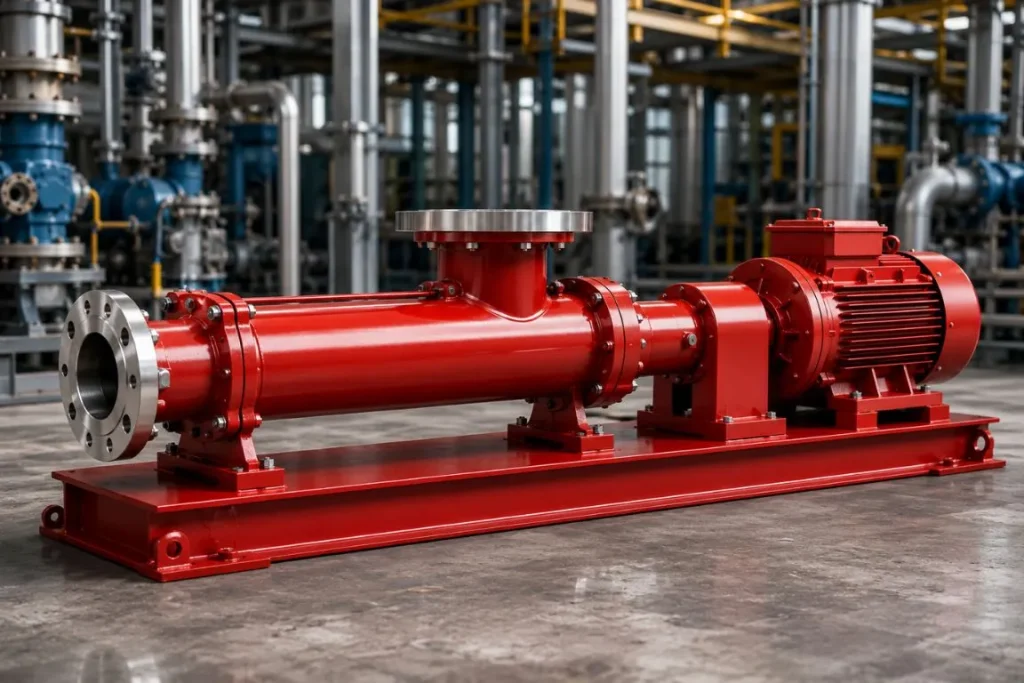
A compact plant still relies on pumps: raw sewage lift, equalization transfer, sludge recirculation, sludge transfer to dewatering, filter feed and chemical dosing. Because space is tight, compact and reliable pumps matter even more.
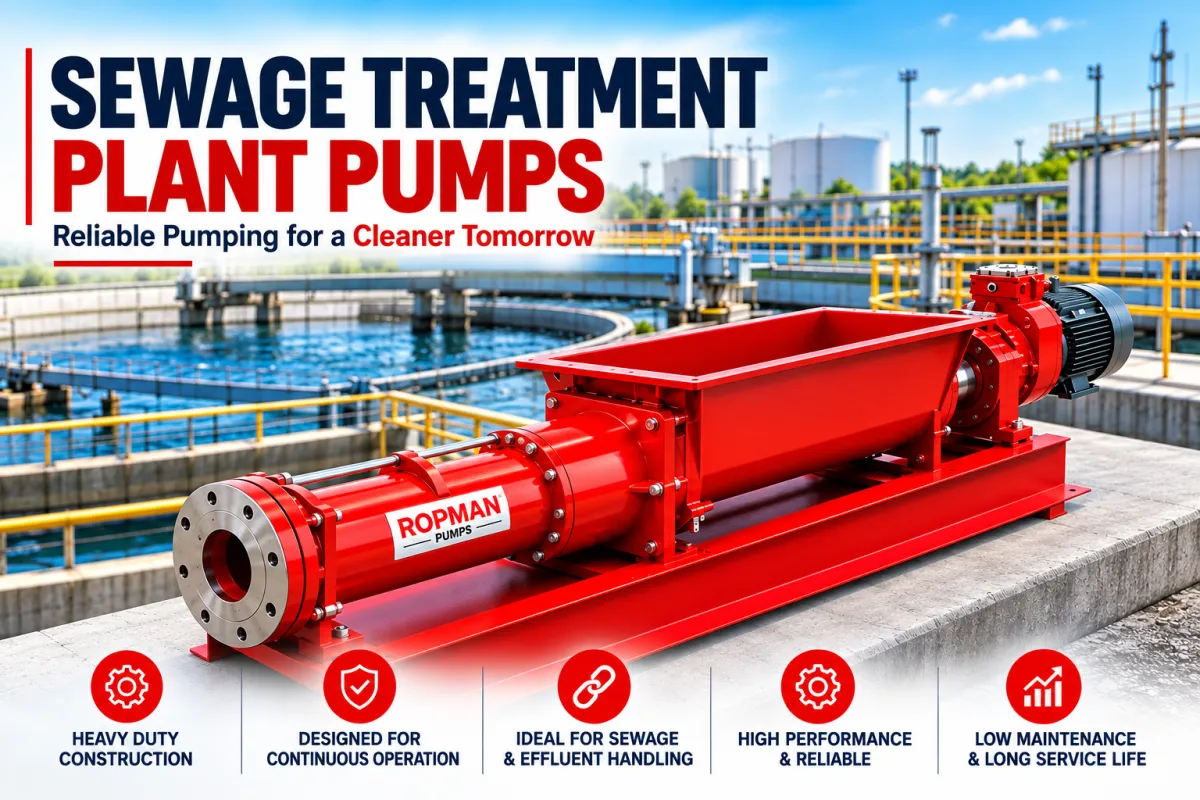
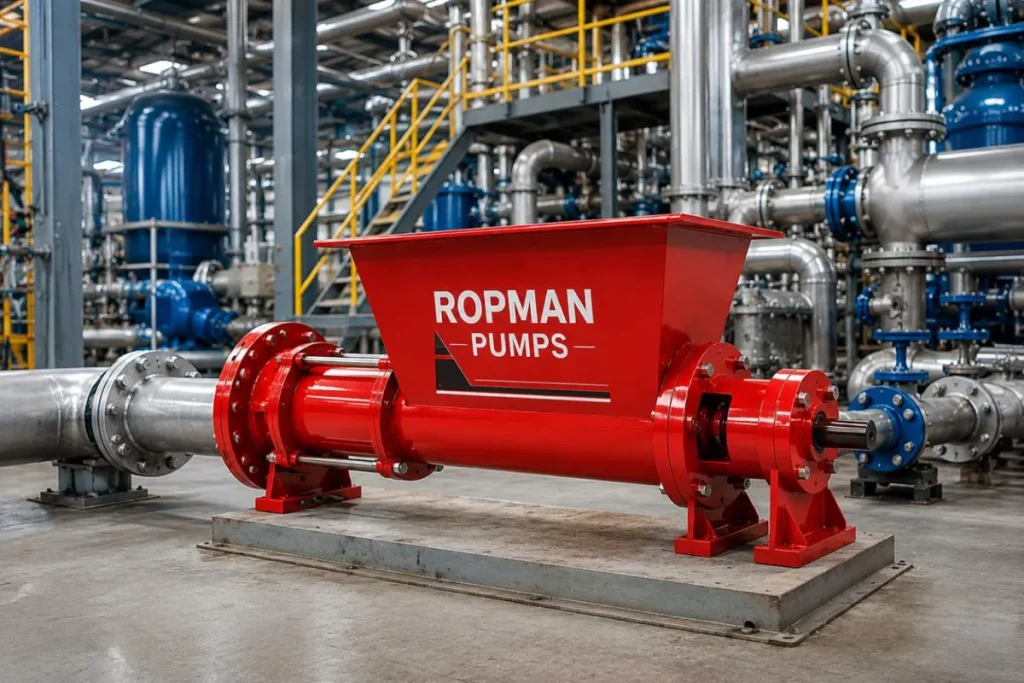
A progressive cavity pump handles thick sludge to a filter press or screw press without clogging and can be mounted on a skid inside a container. Accurate dosing pumps control chlorine and polymer. Ropman Engineering Corporation manufactures both in Meerut and works with STP builders and EPC contractors across India. See our STP pump system guide for more, or read about sewage treatment.
Packaged STP vs Conventional Civil STP
The choice between a factory-built unit and a plant with RCC tanks built on site depends on capacity, timeline, space and budget. This comparison summarises the main differences.
| Factor | Factory-Built Unit | Civil RCC Plant |
|---|---|---|
| Typical capacity | A few KLD to a few hundred KLD | Any size, most economical for large plants |
| Installation time | Weeks | Months |
| Civil work | Plinth or shallow pit | Excavation, RCC, waterproofing, curing |
| Footprint | Compact | Larger, but can be underground |
| Relocation | Possible | Not possible |
| Expansion | Add modules | Needs new tanks or major works |
| Corrosion | FRP or lined tanks resist corrosion | Concrete needs protective coatings |
| Cost per KLD at small sizes | Often competitive | Often higher due to site work |
| Cost per KLD at large sizes | Rises with many modules | Usually lower |
Installation Steps: From Order to Commissioning
- Site survey and sizing: confirm population, flow, inlet quality, treated water needs and available space.
- Design approval: agree process design, layout drawings and equipment list.
- Factory fabrication: tanks, internals, piping, blowers, pumps and panels are built and assembled.
- Factory testing: leak tests on tanks and functional checks on equipment before dispatch.
- Site preparation: a levelled plinth or pit, sewer connection, power supply and treated water outlet are made ready.
- Delivery and placement: modules are lifted into position by crane and levelled.
- Interconnection: inlet, outlet, air and sludge lines and electrical cables are connected.
- Commissioning: the plant is filled, seeded with bacteria and run up to stable treatment over a few weeks.
- Training and handover: operators are trained and O&M manuals handed over.
The biological start-up takes time even when the hardware is ready in days. Seeding with sludge from a healthy running plant helps the bacteria population establish faster.
Choosing the Right Tank Material
FRP
Light, corrosion-proof and easy to transport. Ideal for small and medium units, buried or above ground, as long as the tank is designed for soil and water loads.
Lined Mild Steel
Strong and economical for larger modules. The internal lining must be inspected and maintained to prevent corrosion.
Stainless Steel
Long life and a premium finish, suitable for hospitals, hotels and corrosive environments, at a higher price.
Container Frame
Equipment pre-installed inside a steel container for fast plug-and-play installation and easy relocation.
For buried FRP tanks, ask for the wall thickness, resin type and anchoring arrangement, particularly in areas with high groundwater, where an empty tank can float.
Maintaining a Compact Unit
Compact plants need the same care as large ones, and sometimes more, because there is less buffer for mistakes.
- Clean the inlet screen daily, because blockages back up quickly in small units.
- Check that blowers run evenly and diffusers give uniform bubbling.
- Remove excess sludge regularly; small sludge compartments fill fast.
- Backwash pressure sand and carbon filters on schedule.
- Check chlorine dosing and residual chlorine in the treated water.
- Inspect tank linings and seals during periodic shutdowns.
Our full STP maintenance checklist lists daily, weekly and monthly tasks that apply equally to modular plants.
Mistakes to Avoid When Buying
- Choosing on price per KLD alone without comparing scope, materials and treated water guarantees.
- Undersizing to save money, which leads to poor treatment and odour at peak occupancy.
- Skipping the equalization tank, leaving the compact biology exposed to morning and evening surges.
- Ignoring sludge handling, so sludge is left in the unit until it overflows into treated water.
- No access for maintenance, with covers that cannot be opened or equipment that cannot be lifted out.
- No local service support, which turns small faults into long shutdowns.
The Future of Decentralised Sewage Treatment
Indian cities are increasingly turning to decentralised treatment, where sewage is treated close to where it is generated instead of being piped across the city to one large plant. Factory-built modular systems are well suited to this approach. They let new neighbourhoods, campuses and commercial hubs treat and reuse their own water, reduce the load on overburdened sewers and cut the energy needed to pump sewage long distances.
As water scarcity grows and reuse becomes mandatory in more places, expect to see more of these compact plants combined with remote monitoring, energy-efficient blowers and automated chemical dosing. A well-chosen packaged STP is a practical step towards that future.
Treat water where it is used, reuse it where it is needed: that is the promise of compact, decentralised sewage treatment.
Frequently Asked Questions
What is a packaged STP?
What capacity range do packaged STPs cover?
Which technology is used in a prefabricated STP?
Can a packaged STP be relocated?
Is a packaged STP cheaper than a civil STP?
How long does it take to install a factory-built STP?
Which tank material is best for a compact STP?
Does a compact STP need an equalization tank?
Building or Buying a Packaged STP?
Ropman supplies compact progressive cavity sludge pumps and dosing pumps for packaged and containerised STPs. Share your module size and duties for a recommendation.
Request a Quote