
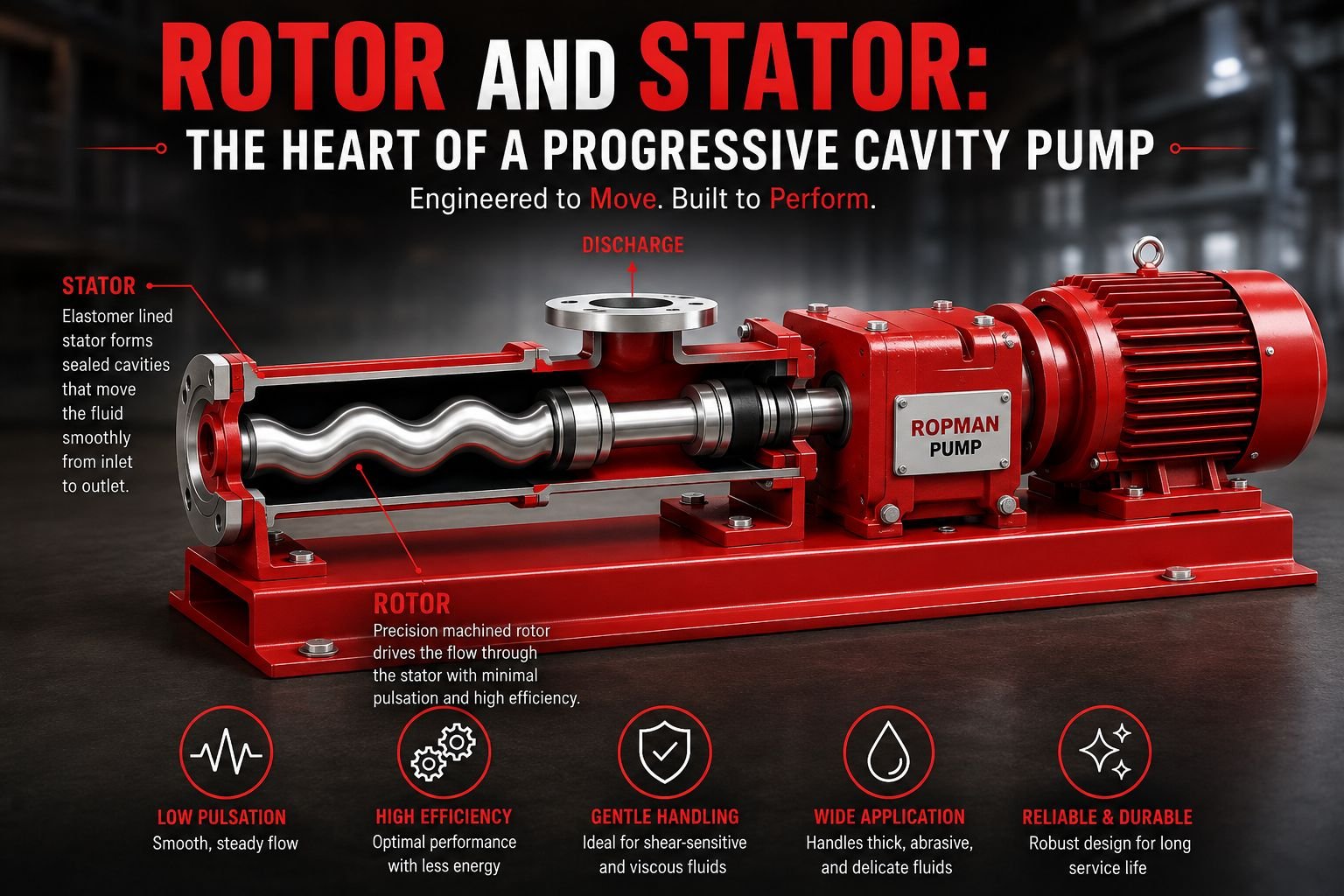
Rotor and Stator: The Heart of a Progressive Cavity Pump
Two simple-looking parts do all the work in a PC pump. Understand them, and you understand why your pump performs — or fails.
Quick Answer
The rotor and stator are the two core components of a progressive cavity pump. The rotor is a helical metal screw that turns inside the stator — a matching elastomer sleeve with one extra lobe. As the rotor rotates, sealed cavities form and move fluid steadily from suction to discharge. The tight interference fit between rotor and stator creates the seal that lets the pump handle thick, abrasive, and shear-sensitive fluids. Their material and fit decide the pump’s flow, pressure, and service life.
Every progressive cavity pump — no matter the size or industry — depends on one pairing to do its job: the rotor and stator. These two parts form the pumping element, and almost every performance figure, wear problem, and maintenance decision traces back to them.
If you run, buy, or maintain PC pumps, understanding the rotor and stator pays off directly in longer life and fewer breakdowns. Let’s break down how the pair works, why materials matter so much, and how to make them last. For the wider mechanism, see this overview of the progressing cavity pump.
What Are the Rotor and Stator?
The rotor and stator are the two mating parts inside a progressive cavity pump that actually move the fluid. Everything else — the drive, bearings, and casing — exists only to support them.
The Rotor
- A single-helix metal screw, usually hardened steel.
- Often chrome-plated or specially coated for wear and corrosion resistance.
- Rotates eccentrically inside the stator.
- Its geometry sets the pump’s flow per revolution.
The Stator
- A double-helix elastomer (rubber) sleeve bonded inside a metal tube.
- Always has one more lobe than the rotor — this is the key to sealing.
- Flexes slightly to grip the rotor and form cavities.
- Its material must match the fluid, temperature, and abrasion.
That one-extra-lobe geometry is the whole secret. Because the stator has one more lobe than the rotor, a series of sealed cavities forms between them — and those cavities are what carry the fluid.
How the Rotor and Stator Work Together
When the rotor turns inside the stator, the space between the two parts forms a chain of sealed cavities. Each cavity holds a fixed volume of fluid and moves steadily from the suction end toward the discharge end as the rotor rotates — like an escalator carrying fluid rather than people.
This is why a progressive cavity pump delivers such smooth, non-pulsating flow. The rotor and stator create a continuous positive displacement action, which gives the pump its signature strengths:
- Steady, gentle flow — ideal for dosing and shear-sensitive fluids.
- Efficiency that rises with viscosity — thick fluids seal the cavities better.
- Solids handling — the flexible stator lets particles pass without jamming.
- Flow proportional to speed — perfect for precise, VFD-controlled metering.
The rotor and stator do not just move fluid — the interference fit between them is the seal. That single design choice is what lets one pump handle honey, sludge, slurry, and chemicals alike.
Why Rotor and Stator Materials Matter So Much
No single rotor and stator combination suits every fluid. Choosing the wrong material is the most common reason PC pumps fail early. The rotor handles hardness and abrasion; the stator handles chemistry and temperature.
Common Rotor Materials
- Hardened tool steel — the standard for general duty.
- Chrome-plated steel — added wear and corrosion resistance.
- Stainless steel — for food, pharma, and corrosive fluids.
- Special coatings — for highly abrasive slurries and mining duty.
Common Stator Elastomers
The stator is made from an elastomer, and the grade must be matched to the fluid:
- Nitrile (NBR) — oils, fuels, and general-purpose duty.
- EPDM — hot water, chemicals, and many acids.
- FKM (Viton) — aggressive chemicals and high temperatures.
- Food-grade rubber — hygienic food, beverage, and pharma fluids.
| Duty | Rotor Choice | Stator Elastomer |
|---|---|---|
| General oils & fuels | Chrome-plated steel | Nitrile (NBR) |
| Hot water & chemicals | Stainless steel | EPDM |
| Aggressive chemicals | Stainless steel | FKM (Viton) |
| Abrasive slurry | Coated / hardened | High-abrasion NBR |
| Food & pharma | Stainless steel | Food-grade rubber |
Rotor and Stator Wear: The Real Cost Driver
The rotor and stator are wear parts — they are designed to be replaced over the pump’s life. Understanding what wears them out is the key to controlling maintenance cost.
What accelerates rotor and stator wear:
- Dry running — even a few minutes without fluid can destroy a stator from friction heat.
- Abrasive solids — sand and grit grind down both parts over time.
- Wrong elastomer — chemical attack swells, hardens, or cracks the stator.
- Excess temperature — softens the rubber and shortens its life.
- Running too fast — higher speed on abrasive duty multiplies wear.
- Over-tight fit — too much interference generates heat and drag.
As the rotor and stator wear, the seal between cavities loosens. This increases internal slip, so flow and pressure gradually drop — the classic sign that a replacement is due.
How to Extend Rotor and Stator Life
A few practical habits dramatically extend the life of any rotor and stator set, cutting both downtime and spare-part spend.
- Fit dry-run protection — the single best safeguard against sudden stator failure.
- Run big and slow — oversize the pump and reduce speed with a VFD on abrasive duty.
- Match the elastomer correctly — to fluid chemistry and temperature, every time.
- Keep spares on the shelf — a stocked rotor and stator turns a breakdown into a quick swap.
- Monitor flow — a slow drop signals wear before a full failure.
Because the rotor and stator are the parts that wear, fast access to correctly made spares is not a luxury — it is what keeps a plant running through the season.
Why In-House Rotor and Stator Manufacturing Matters
Not every pump maker actually produces its own rotor and stator. Many buy them in — which means longer lead times and less control over quality when you need a replacement fast.
At Ropman Engineering Corporation, rotors and stators are manufactured in-house in Meerut, India. That means precise geometry, correct interference fits, the right elastomer for your fluid, and fast spares when a pump is down — instead of waiting weeks for an imported part. Explore our full progressive cavity pump range to see the options.
Frequently Asked Questions
What is the rotor and stator in a progressive cavity pump?
Why does the stator have one more lobe than the rotor?
How often do the rotor and stator need replacing?
What is the most common cause of stator failure?
Can I use any stator material for any fluid?
Conclusion
The rotor and stator really are the heart of a progressive cavity pump. Two simple-looking parts create the sealed cavities that give the pump its smooth flow, viscosity handling, and solids capability — and their material and fit decide how long the pump lasts.
Get the rotor and stator right — correct materials, correct fit, dry-run protection, and fast access to quality spares — and the whole pump rewards you with years of reliable, low-cost service.
Need the Right Rotor and Stator for Your Pump?
Ropman manufactures rotors and stators in-house for fast, correctly-matched spares. Tell us your fluid, temperature, and pump model, and we will supply the right set.
Talk to Our Engineers