
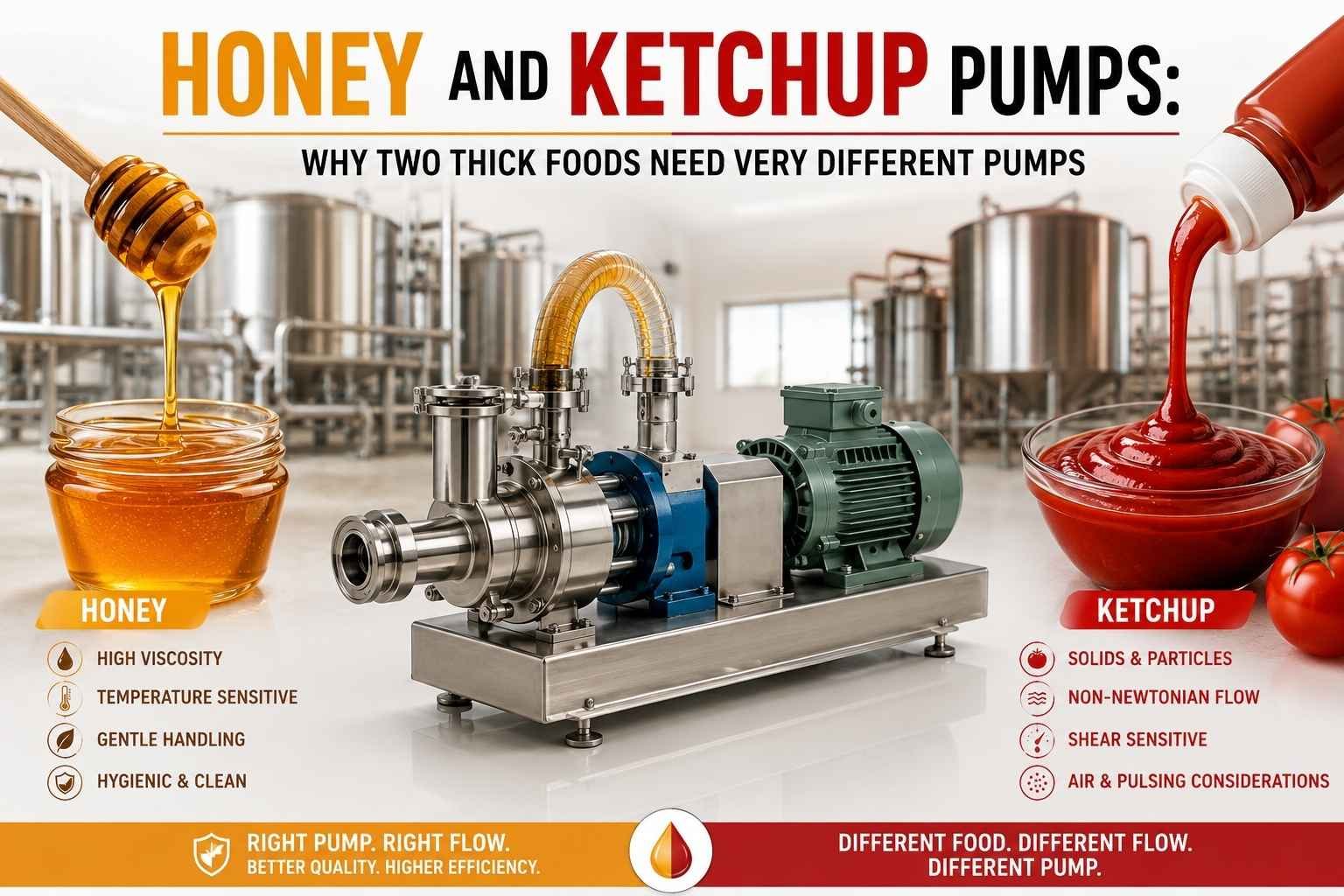
Honey and Ketchup Pumps: Why Two Thick Foods Need Very Different Pumps
Both are thick and sticky — but under a pump they behave in completely opposite ways. Here is what that means for your food plant.
Quick Answer
Honey and ketchup pumps: honey is a Newtonian fluid whose viscosity depends mainly on temperature, while ketchup is a thixotropic fluid that thins when sheared. Honey needs gentle heating and slow, steady flow; ketchup needs low-shear handling to protect its texture and particles. A hygienic, food-grade progressive cavity pump handles both, with CIP cleaning and contamination-resistant stators.
From golden honey and thick ketchup to nut butters, jams, and dessert syrups, viscous foods are everywhere in modern food processing. On the surface, honey and ketchup pumps look like the same problem — thick food, pump it slowly. But that assumption leads to bad pump choices, damaged product, and failed hygiene audits.
Honey and ketchup sit on opposite sides of a fundamental divide in fluid science, and understanding that divide is the single most useful thing to know before buying a food pump. Let’s break down why, and see why a hygienic progressive cavity pump handles both so well.
The Core Difference: How Honey and Ketchup Flow
Most guides treat honey and ketchup pumps as one problem. They are not. The two fluids behave in genuinely opposite ways once a pump starts moving them.
🍯 Honey — Newtonian
- Viscosity stays roughly constant no matter how fast you pump it.
- Extremely sensitive to temperature — cold honey is far thicker.
- Prone to crystallization, which can jam a pump.
- Needs gentle heat and steady, slow flow.
🍅 Ketchup — Thixotropic
- Thick at rest, but thins dramatically when sheared or pumped.
- Contains solid particles — skin, seeds, pulp — that must stay intact.
- Over-shearing ruins texture and separates the product.
- Needs low-shear handling to preserve mouthfeel and consistency.
This is why a pump that is perfect for honey may over-shear ketchup, and a pump sized on ketchup’s flowing viscosity may stall on cold honey. Reading both correctly is the whole game.
What Honey and Ketchup Pumps Must Deliver
Whatever the product, honey and ketchup pumps in a food plant have to satisfy the same non-negotiable requirements, because they touch a consumable food.
Every food-grade pump on these duties must provide:
- Gentle, low-shear transfer that protects flavour, colour, and texture
- Non-pulsating flow for accurate filling and dosing into jars and bottles
- Full hygiene compliance with CIP (Clean-In-Place) and food-grade wetted parts
- Contamination resistance — the right elastomer keeps abrasion particles out of the food
- Gentle solids handling for ketchup’s seeds and pulp without crushing
Why Progressive Cavity Honey and Ketchup Pumps Suit Both
Across honey and ketchup pumps, the hygienic progressive cavity pump is the design that satisfies both fluids at once. As a positive displacement pump it carries product in sealed cavities, which is exactly what viscous food demands.
- Very low shear — protects honey’s clarity and ketchup’s texture alike.
- Efficiency rises with viscosity — thick honey seals the pump and moves cleanly.
- Gentle solids handling — carries ketchup’s particles without crushing them.
- Smooth, steady flow — ideal for precise jar and bottle filling.
- Food-grade, CIP-ready builds — hygienic stators and polished surfaces for audits.
In hygienic pumping, elastomer abrasion is a hidden contamination risk. Choosing the correct food-grade stator — and replacing it before it wears — protects both the product and your audit record.
Pumping Honey: Beat Temperature and Crystallization
Honey pumps live or die by temperature management. Because honey is Newtonian, its viscosity does not fall when you pump harder — the only practical lever is heat. Cold honey can be many times thicker than warm honey, and pushing a pump against it risks motor trips and stalled lines.
- Use gentle heat tracing or a warm-water jacket to hold honey at a workable viscosity.
- Never overheat — excess heat degrades enzymes, flavour, and colour, and can darken premium honey.
- Guard against crystallization in cool lines, which can seize a pump.
- Run the pump slowly to give the thick fluid time to fill each cavity.
Pumping Ketchup: Protect Texture and Particles
Ketchup pumps face the opposite challenge. Ketchup is thixotropic, so it thins as it moves — helpful for flow, but a trap if you over-shear it. Aggressive pumping breaks down the tomato structure, thins the product permanently, and separates liquid from solids.
- Keep pump speed low to minimise shear on the tomato matrix.
- Choose a design that carries seeds and pulp gently, without a chopping action.
- Avoid pumps that create high internal velocities and hot spots.
- Match the pump to ketchup’s flowing viscosity, not its at-rest viscosity, to avoid oversizing.
Honey and Ketchup Pumps: Selection at a Glance
Although both are viscous foods, their pump requirements pull in different directions. This side-by-side comparison makes the choice clear.
| Factor | Honey | Ketchup |
|---|---|---|
| Fluid type | Newtonian | Thixotropic (shear-thinning) |
| Main challenge | Temperature & crystallization | Shear & solid particles |
| Key measure | Gentle heating, slow speed | Low shear, gentle solids handling |
| Viscosity to size on | At coldest operating temperature | Flowing (sheared) viscosity |
| Best pump | Hygienic progressive cavity | Hygienic progressive cavity |
How to Choose Honey and Ketchup Pumps: 5 Steps
Use this sequence to select the right food pump without guesswork. Each step feeds the next.
Your 5-step selection checklist:
- Identify the fluid behaviour — Newtonian (honey) or shear-thinning (ketchup)?
- Set the temperature strategy — heat honey gently; avoid heat that degrades ketchup.
- Check solids and particle integrity — ketchup’s seeds and pulp must survive.
- Specify hygiene — food-grade wetted parts, CIP capability, correct elastomer.
- Size big, run slow — oversize the pump and reduce speed with a VFD for gentle, accurate filling.
Other Foods These Pumps Handle
The same food-grade progressive cavity design that manages honey and ketchup pumps also handles most of the viscous products in a modern food plant.
Pastes & Butters
Peanut butter, sesame paste, tahini, chocolate, and caramel — thick, temperature-critical, and shear-sensitive.
Sauces, Jams & Syrups
Mayonnaise, mustard, dressings, jams with whole fruit pieces, glucose, fruit concentrate, and dessert syrups.
For accurate portioning and filling of these products, honey and ketchup pumps are often paired with dedicated dosing pumps on the line.
Frequently Asked Questions
Which pump is best for honey and ketchup?
Why do honey and ketchup need different handling?
Can a progressive cavity pump handle food safely?
Does honey need heating before pumping?
Why does ketchup separate or thin during pumping?
Conclusion
Honey and ketchup may both be thick, sticky foods, but under a pump they are opposites: one Newtonian and temperature-driven, the other thixotropic and shear-sensitive.
Whichever side of the divide your product sits on, the answer is the same reliable technology — a gentle, hygienic, food-grade pump that protects flavour, texture, and safety. Getting the honey and ketchup pumps decision right the first time saves you from clogging, product damage, and hygiene headaches down the line.
At Ropman Engineering Corporation, we manufacture hygienic food-grade progressive cavity pumps in Meerut, India — with rotors and stators produced in-house for fast spares and long service life. Explore our full progressive cavity pump range to see the options for viscous-food duties.
Honey, Ketchup, or Any Viscous Food — We Pump It Gently
Tell us your product, its viscosity, and your hygiene standard, and our engineers will size the right food-grade pump the first time.