
Screw Pump: How It Works, Types, and Where It Beats Every Other Pump
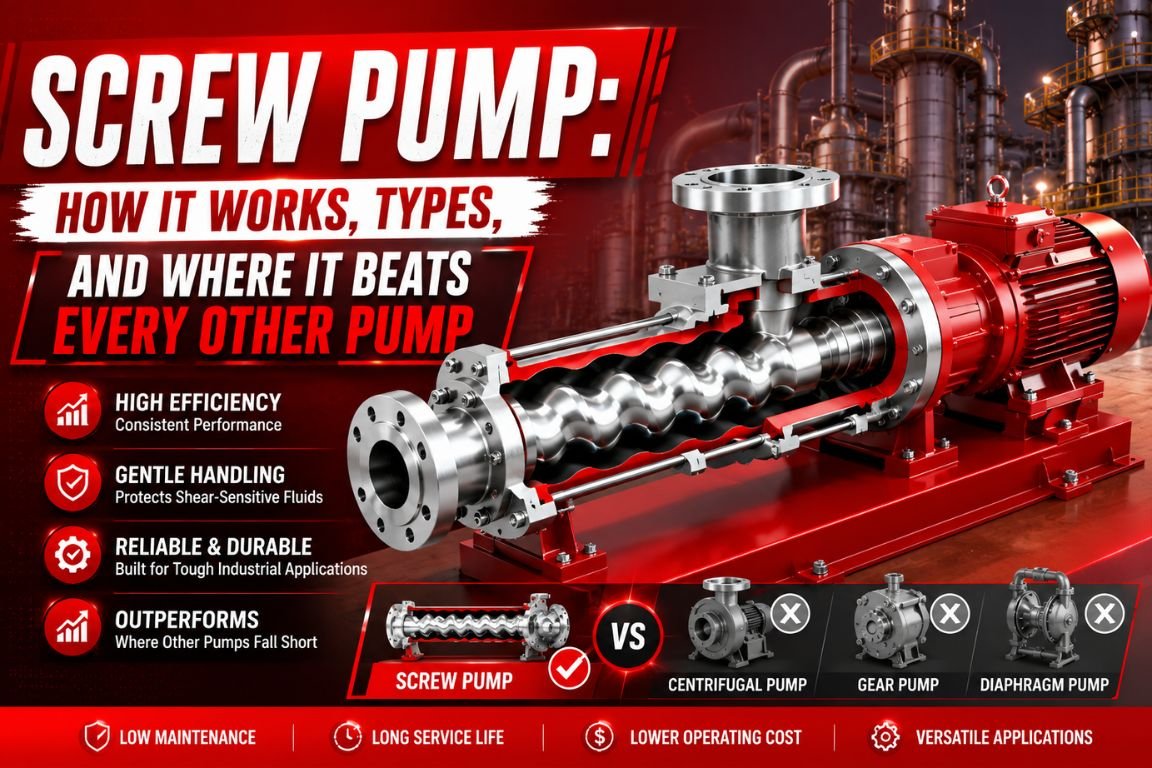
A screw pump is a positive displacement pump that carries liquid forward along its axis inside sealed cavities formed by one or more rotating helical screws. Here is what makes it unusual: while almost every other pump throws liquid at a pipe and hopes for the best, this one picks the fluid up, walks it from inlet to outlet, and sets it down — gently, at a constant volume, every single turn.
That is why it moves molasses, sewage sludge, crude oil, and toothpaste with equal composure. And it is why a plant engineer facing a fluid nobody else can handle usually ends up here.
- A screw pump moves a fixed volume per rotation, so flow stays steady even as pressure rises.
- Three families exist: single screw (progressive cavity), twin screw, and triple screw.
- Thicker fluid actually improves efficiency here — the opposite of a centrifugal pump.
- The performance killer to understand is slip: internal leakage back toward the suction.
- Never run a screw pump dry — seconds without fluid can destroy a stator.
The 2,000-Year-Old Idea Still Running Modern Industry
Around 250 BC, Archimedes described a helix inside a tube that lifted water uphill when you turned it. Farmers along the Nile used it. So did miners draining flooded shafts. The Archimedes screw never really went away — it just got precision-machined, sealed, and asked to do harder things.
The modern version keeps the original insight intact: a rotating helix does not push fluid sideways, it walks it forward. Everything else — the elastomer stators, the timing gears, the 36-bar discharge pressures — is engineering built on top of that one old idea.
How a Screw Pump Works
A screw pump works by trapping liquid in cavities between the rotating threads and the surrounding casing or stator, then moving those cavities steadily toward the discharge. The cycle never stops and never slams:
- A cavity opens at the inlet. Volume expands, pressure drops, and fluid is drawn in — no priming charge needed in most installations.
- The cavity travels. It moves axially along the screw, sealed on all sides, carrying the same volume the whole way. The fluid is not accelerated, chopped, or whipped.
- The cavity closes at the outlet. Fluid leaves in a smooth stream with almost no pulsation.
One rotation equals one fixed volume delivered. Double the speed and you double the flow — a linear relationship that makes these units a natural fit for a variable frequency drive (VFD), and for any process where “how much, exactly?” is the question that matters.
Slip: The Number That Explains Everything
If you only learn one thing about screw pump performance, make it slip — the small amount of fluid that leaks backward through internal clearances, from the high-pressure side toward the suction. It is the gap between theoretical flow and what actually comes out of the pipe.
Two rules follow from it, and they explain most real-world behaviour:
- Higher pressure means more slip. Push harder against a closed system and more fluid squeezes back. Volumetric efficiency falls.
- Higher viscosity means less slip. Thick fluid struggles to leak through tight clearances, so it seals the pump against itself.
That second rule is the quiet superpower. A centrifugal pump gets worse as fluid thickens — it wastes energy churning. A screw pump gets better. Hand it 50,000 cP molasses and it seals up and pumps happily. This single inversion is the reason the technology exists.
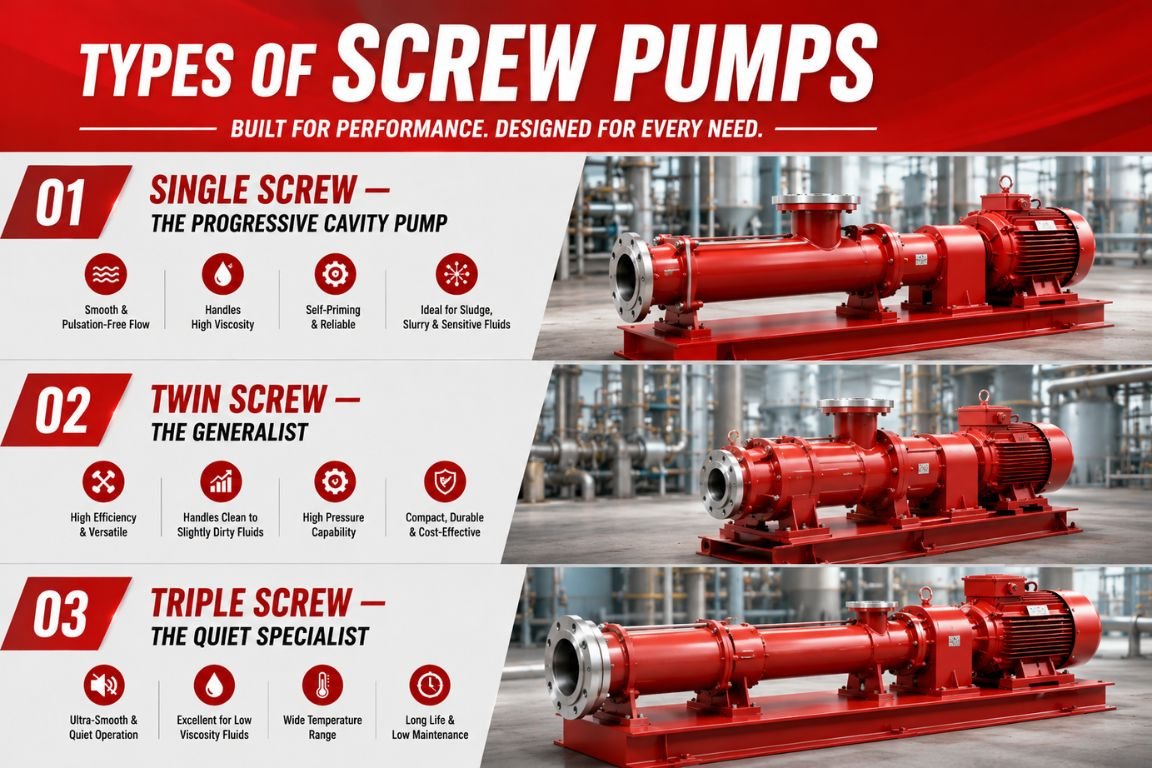
The Three Types of Screw Pumps
There are three families, and they are genuinely different machines solving different problems.
1 Single Screw — the Progressive Cavity Pump
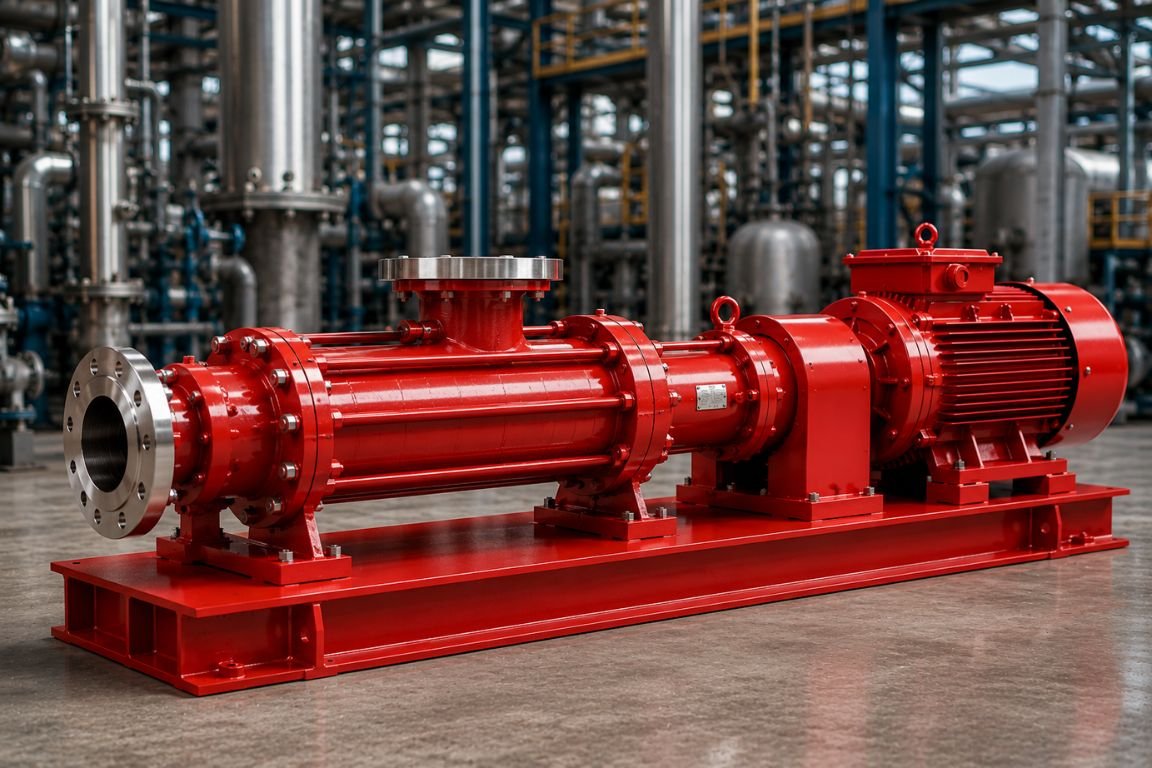
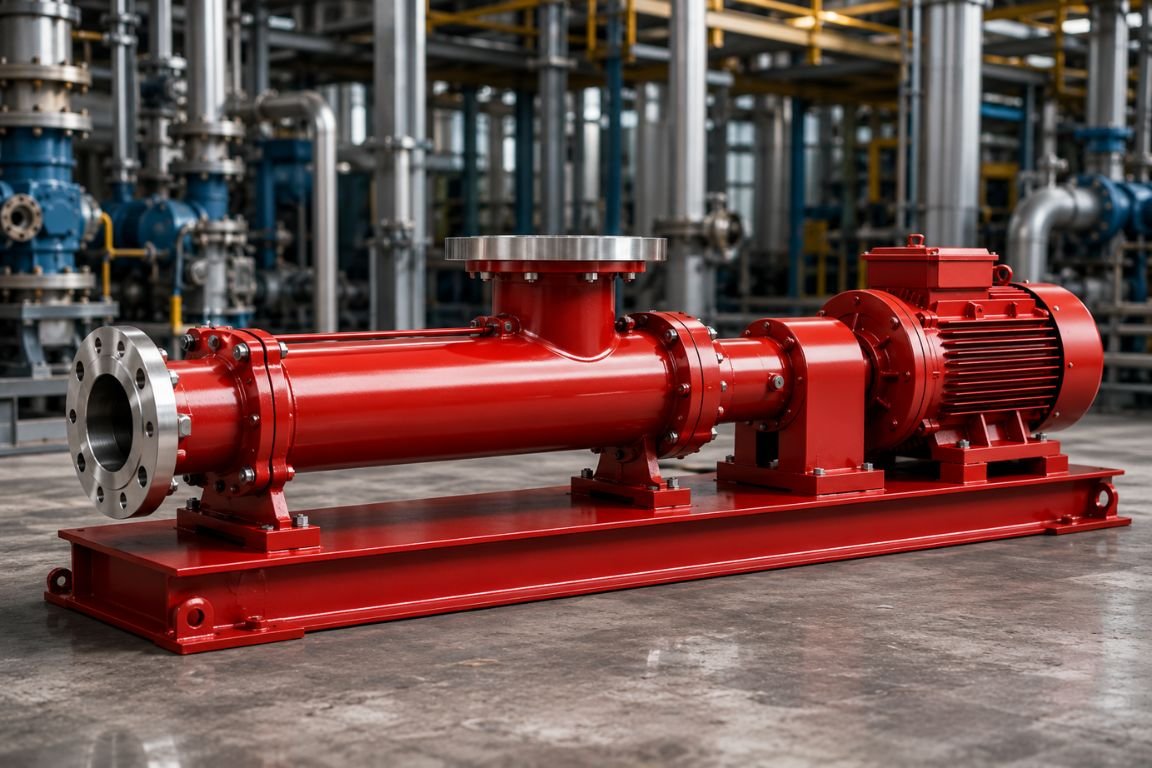
One helical rotor turns eccentrically inside a flexible elastomer stator. Named after René Moineau, who worked out the geometry around 1930, this progressive cavity pump — formally the progressing cavity design — is the single screw pump built for the ugly jobs: sewage sludge, molasses, fruit pulp, drilling mud, anything with soft solids or extreme viscosity.
Its advantage is also its constraint. The rubber stator seals brilliantly against thick, gritty fluid — and it is a wear part. Choose the elastomer for the chemistry (NBR for oils, EPDM for acids and alkalis, Viton for solvents and heat, natural rubber for abrasives) and it will serve for years. Choose it wrong, or run it dry, and it will not.
2 Twin Screw — the Generalist
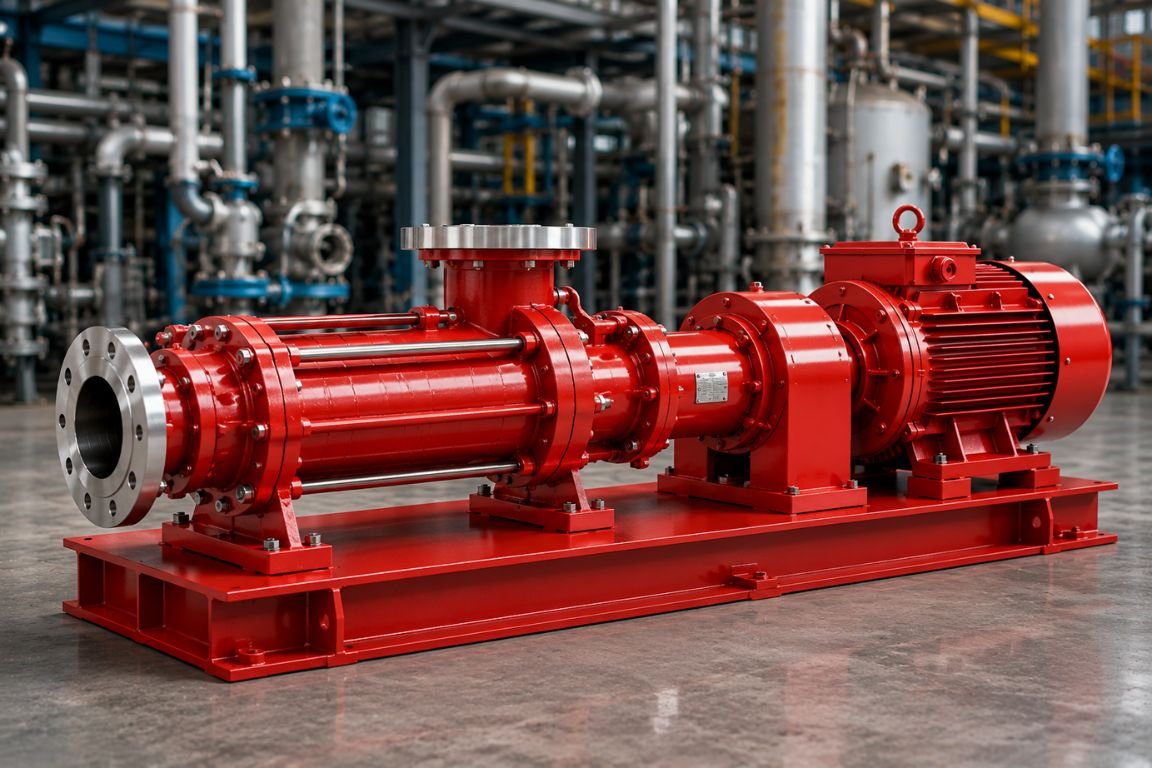
Two screws on parallel shafts, meshing but never touching, held apart by timing gears. Because metal never rubs metal, a twin screw unit tolerates fluids with poor lubricity and handles gas slugs that would stall other designs. It swallows a wide viscosity range and keeps going.
This is the multiphase workhorse of oil terminals and chemical plants — the pump you pick when the fluid keeps changing and you need one machine to cope with all of it.
3 Triple Screw — the Quiet Specialist
One driven central screw, two idlers that follow along, hydraulically balanced. It only works with clean, lubricating fluids — hydraulic oil, lube oil, fuel oil — because the fluid itself is the bearing film. Give it that, and it delivers very high pressure with almost no noise and almost no vibration.
That silence is exactly why it lives in ship engine rooms and power station lube systems, where a rattling pump would be unbearable and downtime unthinkable.
Choosing Between the Three
| Type | Solids | Viscosity | Wear Part | Classic Duty |
|---|---|---|---|---|
| Single (PC) | Yes — soft & abrasive | Thin to extremely thick | Elastomer stator | Sludge, molasses, pulp |
| Twin | Some | Very wide, multiphase | Timing gears, seals | Crude oil, chemicals |
| Triple | None | Clean lubricating only | Idler screws | Hydraulic & lube oil, marine |
← Swipe the table sideways to see all columns
Screw Pump vs Centrifugal Pump
The difference is not a spec-sheet detail — it is a different philosophy of moving liquid. A centrifugal pump spins fluid outward and converts that speed into pressure. A screw pump refuses to rely on speed at all; it simply displaces a fixed volume and dares the pipe to argue.
| Behaviour | Screw Pump | Centrifugal Pump |
|---|---|---|
| Fluid gets thicker | Efficiency improves | Efficiency collapses |
| Discharge valve closes | ⚠️ Pressure spikes — relief valve essential | Simply churns |
| Suction runs dry | ⚠️ Rapid damage | Loses prime, survives |
| Flow control | Linear with speed (VFD) | Throttle the valve |
| Shear on the fluid | Very low — gentle | High |
← Swipe the table sideways to see all columns
⚠️ Note the two warning symbols. A screw pump will not politely give up — close its discharge and it will keep pushing until something fails. A pressure relief valve is not optional.
Where a Screw Pump Earns Its Keep
- Sugar & distillery: molasses at ambient temperature defeats most equipment. Here it is routine.
- Wastewater, ETP & STP: thickened sludge, polymer dosing, filter-press feed.
- Food & beverage: fruit pulp with whole pieces intact — low shear means the product survives the journey.
- Oil & gas: multiphase crude and fuel transfer — see our oil & gas pumping solutions.
- Pharma & chemicals: repeatable metering, often alongside dedicated dosing pumps.
- Paper & pulp: stock and coating slurries that would abrade an impeller flat.
How to Specify One Without Regretting It
Most screw pump failures are specification failures, not manufacturing ones. Answer these before you buy:
- Viscosity at operating temperature — not at room temperature. Molasses at 15°C and at 50°C are different fluids.
- Solids: size, hardness, concentration. Soft solids are fine. Sharp grit changes the elastomer choice entirely.
- Real discharge pressure — including filter fouling and future pipe scaling, not just the clean-system figure.
- Chemical compatibility of the stator — this is the decision people get wrong most often.
- NPSH available vs required. Thick fluid and a long suction line will starve any pump.
- Dry-run risk. If the tank can empty, fit dry-run protection now, not after the first stator dies.
Screw Pump Troubleshooting: Reading the Symptoms
| Symptom | Likely Cause | Action |
|---|---|---|
| Flow dropping gradually | Stator wear increasing slip | Check rotor/stator fit; plan replacement |
| Rattling or knocking | Cavitation or worn joints | Check NPSH, suction line, universal joints |
| Motor overload trips | Pressure too high, or fluid thicker than designed | Verify discharge pressure; check relief valve |
| Stator swollen or cracked | Wrong elastomer, or dry running | Re-select material; add dry-run protection |
| No flow at startup | Reverse rotation | Check phase sequence |
← Swipe the table sideways to see all columns
Four Habits That Double Screw Pump Service Life
Built in Meerut, Running Across India
Ropman Engineering Corporation manufactures single screw (progressive cavity) pumps, hopper-type PC pumps, rota/magma pumps, food-grade stainless units, and dosing pumps — with rotors and stators produced in-house. Our pumps run in sugar, distillery, wastewater, food, chemical, pharmaceutical, paper, and mining plants nationwide. Tell us your fluid, and we will help you specify it properly the first time.
Request a Quote →Frequently Asked Questions
What is a screw pump used for?
It transfers viscous, abrasive, multiphase, or shear-sensitive fluids with smooth, non-pulsating flow. Typical duties include molasses and fermented wash in sugar plants, sludge and polymer in wastewater treatment, fruit pulp and syrups in food processing, and crude, fuel, and lube oil in energy applications.
What are the three types of screw pumps?
The three types are single screw (progressive cavity), twin screw, and triple screw. Single screw handles solids and extreme viscosity, twin screw handles wide-ranging and multiphase fluids, and triple screw handles clean lubricating oils at high pressure with very low noise.
Is a screw pump a positive displacement pump?
Yes. It moves a fixed volume of fluid with every rotation, so flow is proportional to speed and remains largely steady as discharge pressure changes — unlike a centrifugal pump, whose flow falls sharply as pressure rises.
Why does viscosity improve screw pump efficiency?
Because thick fluid resists leaking backward through internal clearances. That internal leakage is called slip, and less slip means higher volumetric efficiency. Viscosity effectively helps the pump seal against itself — the opposite of what happens in a centrifugal pump.
Can a screw pump run dry?
No. Dry running is the single most common cause of failure, particularly in single screw designs where friction destroys the elastomer stator within seconds to minutes. Dry-run protection should be treated as standard, not optional.
Does a screw pump need a pressure relief valve?
Yes. Because it is a positive displacement machine, it will keep building pressure against a closed discharge until the pump, the seal, or the pipework fails. A correctly sized pressure relief valve is a mandatory safety device.